
Calculating Right Triangle is simple and accurate with our free online calculator. Whether you need to find a missing side, determine an angle, or calculate the hypotenuse, this tool provides instant and reliable results using proven mathematical formulas. It is designed for students, teachers, engineers, and anyone working with right triangles. Along with accurate calculations, you’ll also get step-by-step solutions to help you understand every calculation clearly. If you find this tool useful, follow our Facebook page for more free math calculators, learning resources, and updates.
Because of this unique 90-degree constraint, right triangles follow strict geometric laws. If you know just two pieces of information—such as two side lengths, or one side length and one acute angle—you can calculate every remaining side, angle, area, and perimeter.
This comprehensive guide breaks down every formula, step-by-step method, shortcut, and real-world application needed to calculate any right-angled triangle accurately.
Calculating Right Triangle: Understanding the Core Definitions
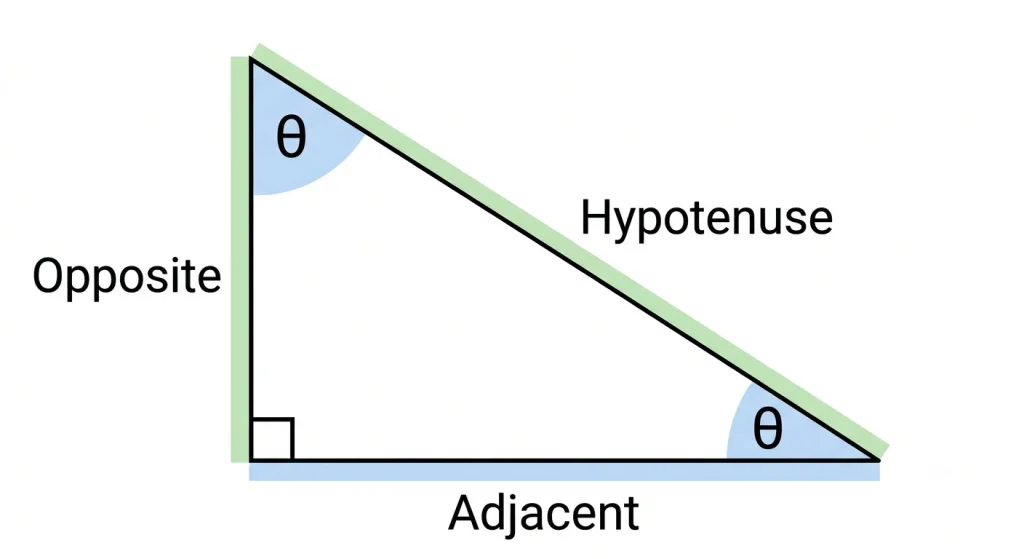
Before calculating a right triangle, it is important to understand the basic parts of a right-angled triangle. Knowing the names and positions of each side helps you choose the correct formula and solve problems accurately. Whether you are using the Pythagorean Theorem or trigonometric ratios, understanding these core definitions makes calculating right triangle measurements faster, easier, and more reliable for students, teachers, engineers, and professionals.
Hypotenuse in Calculating Right Triangle
The hypotenuse ($c$) is the longest side of a right-angled triangle and is always opposite the 90° angle. When calculating right triangle dimensions, the hypotenuse is commonly found using the Pythagorean Theorem or trigonometric formulas.
The Angle Sum Rule
The interior angles of any planar triangle always add up to $180^\circ$. Since a right triangle has one fixed angle of $90^\circ$, the remaining two acute angles ($\alpha$ and $\beta$) must always sum to $90^\circ$:
$$\alpha + \beta = 90^\circ$$
This makes finding a missing angle extremely straightforward when one acute angle is already known.
Method 1: Calculating Right Triangles Using the Pythagorean Theorem
When you know the lengths of any two sides of a right triangle, the most reliable tool is the Pythagorean Theorem. Named after the ancient Greek mathematician Pythagoras, this formula states that the square of the hypotenuse equals the sum of the squares of the other two sides.
The Pythagorean Formula
$$a^2 + b^2 = c^2$$
Where:
- $a$ = length of Leg 1
- $b$ = length of Leg 2
- $c$ = length of the Hypotenuse
Scenario A: Finding the Hypotenuse ($c$)
If you know both legs ($a$ and $b$), solve for $c$ by taking the square root of their sum:
$$c = \sqrt{a^2 + b^2}$$
Step-by-Step Example:
Calculate the hypotenuse of a right triangle where $a = 6\text{ cm}$ and $b = 8\text{ cm}$.
- Square both side lengths: $6^2 = 36$ and $8^2 = 64$.
- Add the squared values together: $36 + 64 = 100$.
- Take the square root of the sum: $c = \sqrt{100} = 10\text{ cm}$.
Scenario B: Finding a Missing Leg ($a$ or $b$)
If you know the hypotenuse ($c$) and one leg length ($b$), rearrange the formula to solve for the missing leg ($a$):
$$a = \sqrt{c^2 – b^2}$$
$$b = \sqrt{c^2 – a^2}$$
Step-by-Step Example:
Calculate leg $a$ when hypotenuse $c = 13\text{ m}$ and leg $b = 5\text{ m}$.
- Square the known values: $13^2 = 169$ and $5^2 = 25$.
- Subtract the smaller square from the hypotenuse square: $169 – 25 = 144$.
- Take the square root: $a = \sqrt{144} = 12\text{ m}$.
Method 2: Calculating Right Triangles Using Trigonometry
When you know one side length and one acute angle, the Pythagorean theorem alone is not enough. You must use trigonometric ratios: Sine (sin), Cosine (cos), and Tangent (tan).
Memory aid: SOH CAH TOA
- SOH: $\sin(\theta) = \frac{\text{Opposite}}{\text{Hypotenuse}}$
- CAH: $\cos(\theta) = \frac{\text{Adjacent}}{\text{Hypotenuse}}$
- TOA: $\tan(\theta) = \frac{\text{Opposite}}{\text{Adjacent}}$
Formula Matrix for Right Triangle Trigonometry
| Known Variables | Variable to Calculate | Formula to Apply |
| Hypotenuse ($c$), Angle ($\theta$) | Opposite Side ($a$) | $a = c \cdot \sin(\theta)$ |
| Hypotenuse ($c$), Angle ($\theta$) | Adjacent Side ($b$) | $b = c \cdot \cos(\theta)$ |
| Adjacent Side ($b$), Angle ($\theta$) | Opposite Side ($a$) | $a = b \cdot \tan(\theta)$ |
| Opposite Side ($a$), Angle ($\theta$) | Hypotenuse ($c$) | $c = \frac{a}{\sin(\theta)}$ |
| Adjacent Side ($b$), Angle ($\theta$) | Hypotenuse ($c$) | $c = \frac{b}{\cos(\theta)}$ |
Step-by-Step Trigonometry Example
Problem: A right triangle has an acute angle $\theta = 30^\circ$ and an adjacent side length $b = 10\text{ meters}$. Calculate the opposite side ($a$) and the hypotenuse ($c$).
Step 1: Find the Opposite Side ($a$)
Use the Tangent formula:
$$a = b \cdot \tan(30^\circ)$$
$$a = 10 \cdot 0.57735 = 5.77\text{ meters}$$
Step 2: Find the Hypotenuse ($c$)
Use the Cosine formula:
$$c = \frac{b}{\cos(30^\circ)}$$
$$c = \frac{10}{0.8660} = 11.55\text{ meters}$$
Step 3: Calculate the Remaining Angle ($\beta$)
$$\beta = 90^\circ – 30^\circ = 60^\circ$$
Method 3: Finding Angles from Side Lengths (Inverse Trigonometry)
If you have two side lengths and need to find the internal angles, use the inverse trigonometric functions ($\arcsin$, $\arccos$, $\arctan$ or $\sin^{-1}$, $\cos^{-1}$, $\tan^{-1}$).
- To find angle $\theta$ using Opposite and Hypotenuse:$$\theta = \arcsin\left(\frac{\text{Opposite}}{\text{Hypotenuse}}\right)$$
- To find angle $\theta$ using Adjacent and Hypotenuse:$$\theta = \arccos\left(\frac{\text{Adjacent}}{\text{Hypotenuse}}\right)$$
- To find angle $\theta$ using Opposite and Adjacent:$$\theta = \arctan\left(\frac{\text{Opposite}}{\text{Adjacent}}\right)$$
Shortcut: Special Right Triangles
Certain right triangles appear frequently in standardized testing, engineering calculations, and architecture. Memorizing these shortcuts saves significant calculation time.
1. The 45-45-90 Right Triangle (Isosceles Right Triangle)
- Angle Ratio: $45^\circ : 45^\circ : 90^\circ$
- Side Ratio: $1 : 1 : \sqrt{2}$
- Both legs are equal ($a = b$).
- The hypotenuse is always equal to leg length multiplied by $\sqrt{2}$ ($\approx 1.414$).
2. The 30-60-90 Right Triangle
- Angle Ratio: $30^\circ : 60^\circ : 90^\circ$
- Side Ratio: $1 : \sqrt{3} : 2$
- The side opposite the $30^\circ$ angle is the shortest leg ($x$).
- The hypotenuse is always twice the shortest leg ($2x$).
- The side opposite the $60^\circ$ angle is $x\sqrt{3}$ ($\approx 1.732x$).
3. Common Pythagorean Triples
Pythagorean triples are sets of three positive integers that satisfy $a^2 + b^2 = c^2$ perfectly:
- 3 – 4 – 5 (and scaled multiples: 6-8-10, 9-12-15)
- 5 – 12 – 13
- 8 – 15 – 17
- 7 – 24 – 25
How to Calculate Area and Perimeter of a Right Triangle
Calculating Area
The area of a right-angled triangle is the amount of two-dimensional space enclosed by its three sides. When calculating right triangle area, the two perpendicular sides ($a$ and $b$) serve as the base and height, making the calculation simple and accurate. By applying the correct formula, you can quickly determine the area for geometry, engineering, construction, and everyday mathematical problems.
$$\text{Area} = \frac{1}{2} \times \text{Base} \times \text{Height} = \frac{a \times b}{2}$$
Example:
If leg $a = 6\text{ cm}$ and leg $b = 8\text{ cm}$:
$$\text{Area} = \frac{6 \times 8}{2} = 24\text{ cm}^2$$
Calculating Perimeter
The perimeter is the total boundary distance around the triangle:
$$\text{Perimeter} = a + b + c$$
Example:
Using the same triangle ($a=6$, $b=8$, $c=10$):
$$\text{Perimeter} = 6 + 8 + 10 = 24\text{ cm}$$
Practical Real-World Applications
Right triangle calculations are not restricted to textbook geometry. Here are four common real-world use cases:
- Roof Pitch & Carpentry: Roof framing relies on calculating rise (vertical leg), run (horizontal leg), and rafter length (hypotenuse).
- Surveying and Navigation: Land surveyors use the tangent function to calculate building heights or terrain elevation differences without physically climbing them.
- Computer Graphics & Game Development: Game engines calculate distances between vectors, collision boundaries, and ray-casting angles using Pythagorean distance formulas:$$d = \sqrt{(x_2 – x_1)^2 + (y_2 – y_1)^2}$$
- Ladder Safety Rule: OSHA standards recommend a 4:1 ladder ratio (for every 4 feet of height, place the ladder base 1 foot out from the wall). Calculating the hypotenuse gives the exact ladder length required for safe access.
Key Takeaways
- A right-angled triangle contains one $90^\circ$ angle, making its acute angles complementary ($\alpha + \beta = 90^\circ$).
- Use $a^2 + b^2 = c^2$ when two side lengths are known.
- Use trigonometric ratios (SOH CAH TOA) when working with one side and one acute angle.
- Inverse trigonometric functions ($\arcsin$, $\arccos$, $\arctan$) derive angles from side lengths.
- Area is calculated quickly using $\frac{a \times b}{2}$, using the two perpendicular legs as base and height.
Frequently Asked Questions (FAQ)
1. How do you calculate a right triangle with only 1 side given?
To calculate a right triangle with only one side given, you must also know at least one acute angle (in addition to the $90^\circ$ right angle). With one side and one angle, you can use trigonometric functions ($\sin$, $\cos$, or $\tan$) to find all remaining sides and angles.
2. Can a right triangle have two right angles?
No. The interior angles of any triangle in Euclidean geometry must equal $180^\circ$. If a triangle had two $90^\circ$ angles, their sum alone would equal $180^\circ$, leaving $0^\circ$ for the third angle, which renders a triangle impossible.
3. What is the formula for the hypotenuse of a right triangle?
The formula for the hypotenuse ($c$) is derived from the Pythagorean theorem: $c = \sqrt{a^2 + b^2}$, where $a$ and $b$ are the lengths of the two perpendicular legs.
4. How do you find the angle of a right triangle without a calculator?
You can estimate angles using standard special right triangle ratios ($30^\circ-60^\circ-90^\circ$ or $45^\circ-45^\circ-90^\circ$), or by using common Pythagorean triples like $3-4-5$ (where the angles are approximately $36.87^\circ$, $53.13^\circ$, and $90^\circ$).
5. What is the difference between a right triangle and an oblique triangle?
A right triangle contains exactly one $90^\circ$ angle, allowing the use of the Pythagorean theorem and basic SOH CAH TOA trigonometry. An oblique triangle contains no $90^\circ$ angles and requires the Law of Sines or Law of Cosines to solve.
6. Is the hypotenuse always the longest side?
Yes. In any triangle, the longest side is always opposite the largest angle. Since the right angle ($90^\circ$) is the largest angle in a right triangle, the hypotenuse opposite it is always the longest side.
7. How do you calculate right triangle area when only the hypotenuse and one angle are known?
First, find the legs using $a = c \cdot \sin(\theta)$ and $b = c \cdot \cos(\theta)$. Then calculate the area using $\text{Area} = \frac{a \times b}{2}$. Combined, the direct formula is $\text{Area} = \frac{c^2 \cdot \sin(\theta) \cdot \cos(\theta)}{2}$.
8. What is a Pythagorean Triple?
A Pythagorean triple consists of three positive integers $(a, b, c)$ that satisfy $a^2 + b^2 = c^2$. Examples include $(3, 4, 5)$, $(5, 12, 13)$, and $(8, 15, 17)$.
Conclusion
Calculating Right Triangle is easy when you understand which formula to use for the information you already have. Whether you’re finding a missing side with the Pythagorean Theorem or solving for angles using trigonometric ratios, the correct method ensures accurate results every time. Our Calculating Right Triangle tool simplifies the entire process by providing instant answers and clear step-by-step solutions. Whether you’re a student, teacher, engineer, architect, or DIY enthusiast, Calculating Right Triangle becomes faster, easier, and more reliable with the right calculator and formulas.