
Understanding right-angled triangles becomes straight forward once you learn the pythagorean theorem equation. Whether you are solving algebra problems, designing 2D graphics, or measuring distances in real-life construction, this fundamental geometry rule provides a quick way to find any missing side length of a right-angled triangle.
What Is the Pythagorean Theorem Equation?
The pythagorean theorem equation states that in any right-angled triangle, the area of the square built on the hypotenuse is equal to the sum of the areas of the squares built on the other two sides.
A right triangle is defined as any three-sided polygon that contains one internal angle measuring exactly 90 degrees. The two sides that form this right angle are called legs, while the longest side opposite the right angle is called the hypotenuse.
The standard algebraic formula is written as:
a² + b² = c²
Where:
- a = length of the first leg (shorter side)
- b = length of the second leg (shorter side)
- c = length of the hypotenuse (the longest side opposite the 90-degree angle)
How to Use the Pythagorean Theorem Equation Step-by-Step
To calculate an unknown side length using the pythagorean theorem equation, you only need to know two out of the three sides. Follow these simple step-by-step calculations:
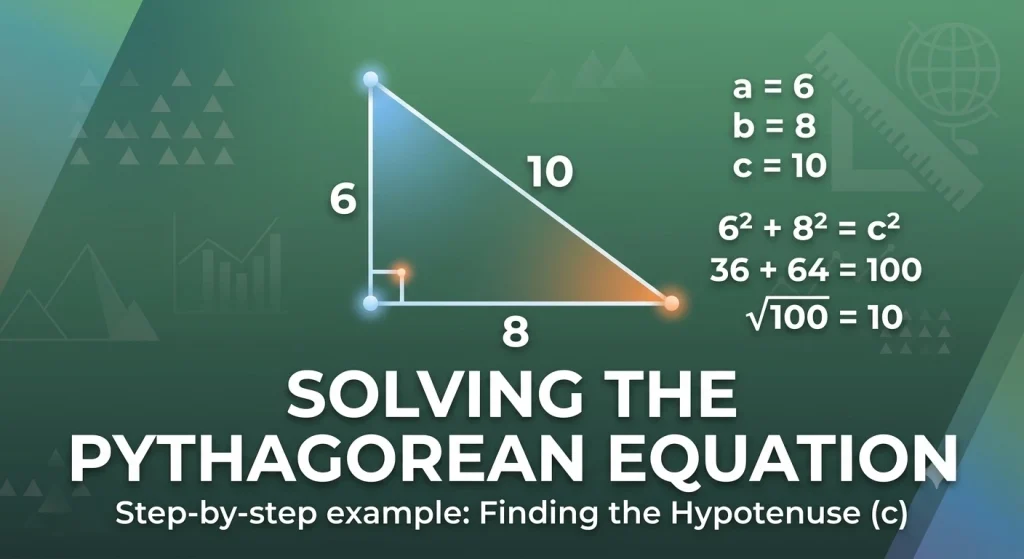
Example 1: Finding the Unknown Hypotenuse (c)
Suppose you are given a right triangle with legs measuring a = 6 and b = 8.
- Step 1: Write down the fundamental formula:a² + b² = c²
- Step 2: Substitute the known numerical values into the variables:6² + 8² = c²
- Step 3: Square each number individually:36 + 64 = c²
- Step 4: Add the squared results together:100 = c²
- Step 5: Take the square root of both sides to isolate the value of c:c = √100c = 10
The hypotenuse length is 10.
Example 2: Finding a Missing Leg (a or b)
Sometimes you already know the hypotenuse length but need to figure out one of the perpendicular legs. Suppose you know the hypotenuse c = 13 and one leg b = 12, but you need to calculate leg a.
- Step 1: Start with the standard formula:a² + b² = c²
- Step 2: Rearrange the formula to isolate a²:a² = c² – b²
- Step 3: Substitute the given measurements:a² = 13² – 12²
- Step 4: Calculate the squares and subtract the smaller value from the larger value:a² = 169 – 144a² = 25
- Step 5: Take the square root of both sides:a = √25a = 5
The missing side a is 5.
Common Integer Sets (Pythagorean Triples)
Certain whole-number combinations satisfy the pythagorean theorem equation perfectly without requiring decimal conversions or complex square root rounding. Mathematics refers to these exact integer sets as Pythagorean triples:
| Side a | Side b | Hypotenuse (c) | Equation Check (a² + b² = c²) |
| 3 | 4 | 5 | 3² + 4² = 9 + 16 = 25 (5²) |
| 5 | 12 | 13 | 5² + 12² = 25 + 144 = 169 (13²) |
| 8 | 15 | 17 | 8² + 15² = 64 + 225 = 289 (17²) |
| 7 | 24 | 25 | 7² + 24² = 49 + 576 = 625 (25²) |
| 9 | 40 | 41 | 9² + 40² = 81 + 1600 = 1681 (41²) |
Important Rules and Conditions to Remember
While the pythagorean theorem equation is extremely versatile, you must keep three essential rules in mind when applying it:
- Only Applies to Right Triangles: This formula cannot be directly applied to acute or obtuse triangles without using advanced trigonometry like the Law of Cosines.
- Hypotenuse is Always ‘c’: The longest side must always represent c in the formula. Swapping a and b does not change the result, but placing the hypotenuse in position a or b will cause incorrect results.
- Always Square Root at the End: A common mistake is stopping at c² instead of taking the final square root to find the actual length of side c.
Real-World Applications
The pythagorean theorem equation extends far beyond simple geometry worksheets:
- Construction & Carpentry: Builders use the 3-4-5 rule derived from this formula to verify that corner frames form precise 90-degree right angles.
- Navigation & Mapping: GPS tools and aviation systems calculate exact diagonal distance between two coordinate coordinates across flat planes.
- Computer Graphics & Game Development: Developers rely on this equation to render two-dimensional spatial movement, camera distances, and object hitboxes efficiently.
Additional Resources and Tools
To test your calculations or review interactive visual examples, explore this complete Pythagorean theorem guide with formula cheat sheet and online calculator.