
Solving a right triangle becomes much easier when you know which sides are available and which measurement you need to find. An online Pythagorean Theorem Calculator can quickly calculate a missing side when the other two side lengths are known.
The Pythagorean Theorem is based on a simple relationship:
a² + b² = c²
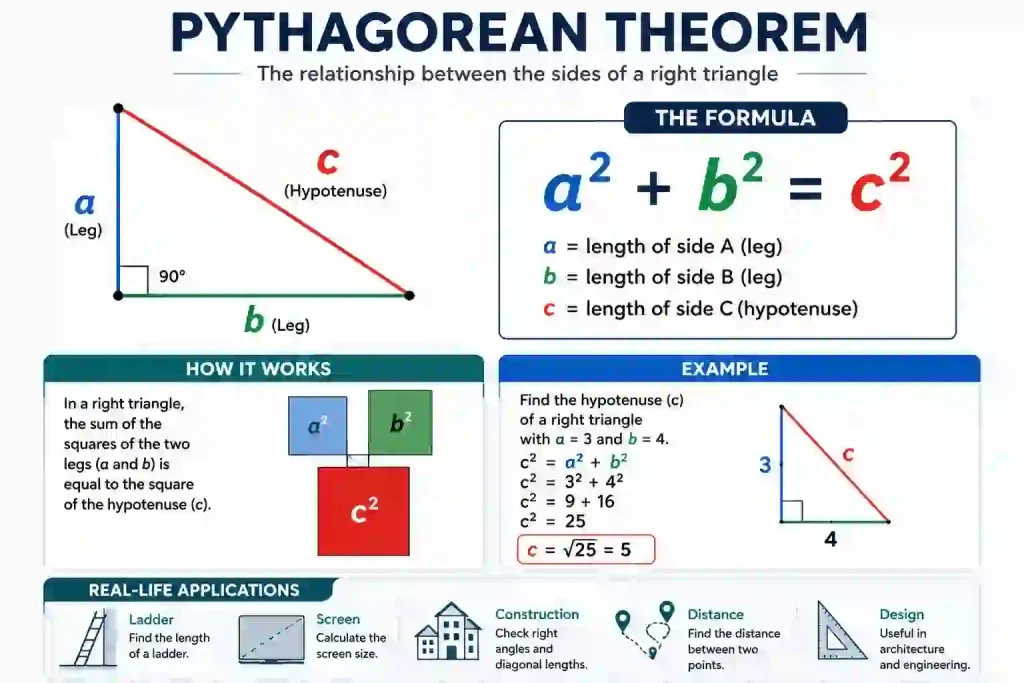
Here, a and b are the legs of a right triangle, while c is the hypotenuse. The hypotenuse is the longest side and is always opposite the 90-degree angle.
If you want to calculate a missing side quickly, you can use our Pythagorean Theorem Calculator.
What Is an Online Pythagorean Theorem Calculator?
An online Pythagorean Theorem Calculator is a web-based tool designed to solve right-triangle problems using the Pythagorean relationship.
Instead of calculating squares, subtraction, and square roots manually, you can enter the known measurements and let the calculator perform the mathematical operations.
These calculators are particularly useful when:
- You need to find the hypotenuse
- One leg of a right triangle is missing
- You want to verify a manual calculation
- You are working with decimal measurements
- You need a quick answer for a geometry problem
The important thing to remember is that the standard Pythagorean Theorem applies to right triangles, which contain one 90-degree angle.
How Does the Pythagorean Theorem Work?
The theorem states that the square of the hypotenuse is equal to the sum of the squares of the two legs.
The formula is:
a² + b² = c²
Suppose a right triangle has:
- Side A = 3
- Side B = 4
To find the hypotenuse:
c² = 3² + 4²
c² = 9 + 16
c² = 25
Now take the square root:
c = √25
c = 5
Therefore, the hypotenuse is 5 units.
This is the well-known 3-4-5 Pythagorean triple.
How to Find the Hypotenuse
When both legs of a right triangle are known, use:
c = √(a² + b²)
For example, if Side A is 8 units and Side B is 15 units:
c = √(8² + 15²)
c = √(64 + 225)
c = √289
c = 17
The hypotenuse is therefore 17 units.
You can perform this calculation manually, or use a Pythagorean Theorem Calculator to get the result more quickly.
How to Find a Missing Leg
The theorem can also be rearranged when the hypotenuse and one leg are known.
To find a missing leg, use:
a = √(c² – b²)
or
b = √(c² – a²)
For example, suppose:
- Hypotenuse = 13
- Known leg = 5
To find the other leg:
b = √(13² – 5²)
b = √(169 – 25)
b = √144
b = 12
So the missing leg is 12 units.
How to Use an Online Pythagorean Theorem Calculator
Most dedicated Pythagorean calculators follow a simple process.
Step 1: Identify the Right Angle
First, make sure the triangle has a 90-degree angle. The side opposite this angle is the hypotenuse.
Step 2: Identify the Known Sides
Determine which two measurements are already available.
You may know:
- Both legs
- One leg and the hypotenuse
Step 3: Enter the Measurements
Enter the known values into the appropriate calculator fields.
Step 4: Select the Missing Side
Depending on the calculator, you may need to specify which side you want to calculate.
Step 5: Review the Result
The calculator will apply the appropriate version of the Pythagorean formula and provide the missing measurement.
Some online tools can also provide additional information such as the triangle’s area and perimeter.
Omni Calculator and Pythagorean Theorem Calculations
Omni Calculator is a large online collection of calculators covering mathematics and many other categories. Its Pythagorean Theorem Calculator is designed to calculate a missing side of a right triangle when the other two sides are known.
The Omni calculator allows users to enter side lengths and can calculate the hypotenuse or a missing leg. It also provides options to display the area and perimeter of the triangle.
This makes Omni useful as a general mathematical resource, especially when you need different types of calculators in addition to Pythagorean calculations.
For a focused right-triangle calculation, you can also use our Pythagorean Theorem Calculator.
Pythagorean Theorem Calculator vs. Manual Calculation
Both manual calculations and online calculators have advantages.
Manual Calculation
When solving manually, you can see every mathematical step and understand how the formula works.
For example:
a² + b² = c²
If a = 6 and b = 8:
6² + 8² = c²
36 + 64 = c²
100 = c²
c = 10
This approach is useful for students who are learning the theorem.
Online Calculator
An online calculator is more convenient when you need a quick result or want to verify your answer.
It can help reduce arithmetic mistakes and save time when working through multiple problems.
The best approach is to understand the formula first and then use a calculator to verify or speed up your calculations.
When Should You Use a Pythagorean Theorem Calculator?
An online calculator can be useful in many situations.
School and Homework
Students can use a calculator to check answers after solving geometry problems manually.
Construction
Right-triangle calculations can help with diagonal measurements, slopes, framing, and other dimensional problems.
Ladder Problems
A ladder leaning against a wall forms a right triangle. If you know the height reached on the wall and the distance from the wall, you can calculate the ladder length.
For example:
- Wall height = 4 meters
- Distance from wall = 3 meters
The ladder length is:
c = √(4² + 3²)
c = √25
c = 5 meters
Distance Measurements
If horizontal and vertical distances are known, the theorem can be used to determine the straight-line distance between two points.
Screen Diagonals
The diagonal of a rectangular screen can also be calculated when its width and height are known.
Common Pythagorean Triples
Some groups of whole numbers satisfy the Pythagorean equation exactly.
Common examples include:
- 3, 4, 5
- 5, 12, 13
- 8, 15, 17
- 7, 24, 25
- 20, 21, 29
For example:
8² + 15² = 17²
64 + 225 = 289
Therefore, 8, 15, and 17 form a Pythagorean triple.
You can learn more about this topic in our guide to Pythagorean triples.
Common Mistakes to Avoid
Using a calculator does not replace understanding the problem. Make sure you avoid these common mistakes.
Choosing the Wrong Hypotenuse
The hypotenuse is always opposite the 90-degree angle.
Using the Theorem on the Wrong Triangle
The standard Pythagorean Theorem is specifically for right triangles.
Entering the Wrong Units
If one measurement is in meters and another is in centimeters, convert them to the same unit before calculating.
Forgetting the Square Root
The equation initially gives you the square of the missing side. You must take the square root to obtain the actual length.
Pythagorean Theorem Calculator for Decimal Values
The theorem is not limited to whole numbers. You can also work with decimal measurements.
For example, suppose:
- Side A = 4.5
- Side B = 6.2
The hypotenuse can be found using:
c = √(4.5² + 6.2²)
An online calculator can handle the decimal calculations quickly and provide a suitable result.
For greater accuracy, keep additional decimal places during intermediate calculations and round the final answer according to the requirements of your problem.
Frequently Asked Questions
What is an online Pythagorean Theorem Calculator?
It is a web-based tool that uses the Pythagorean Theorem to calculate a missing side of a right triangle.
What formula does a Pythagorean calculator use?
The basic formula is:
a² + b² = c²
The calculator rearranges this formula when it needs to find a missing leg instead of the hypotenuse.
Can a Pythagorean calculator find the hypotenuse?
Yes. When both legs are known, the calculator can find the hypotenuse using:
c = √(a² + b²)
Can I calculate a missing leg?
Yes. If you know the hypotenuse and one leg, you can calculate the other leg.
Can I use decimal numbers?
Yes. Pythagorean calculations work with decimal measurements as long as the values represent the sides of a valid right triangle.
Is Omni Calculator useful for Pythagorean problems?
Yes. Omni Calculator provides a dedicated Pythagorean Theorem Calculator that can calculate missing sides of right triangles and can also provide area and perimeter information.
What is the difference between a Pythagorean calculator and a right triangle calculator?
A Pythagorean calculator focuses primarily on the relationship between the three sides of a right triangle. A more comprehensive right triangle calculator may also use angles and trigonometric functions to solve additional triangle measurements.
Final Thoughts
The Pythagorean Theorem provides a straightforward way to calculate missing side lengths in right triangles. Once you know which side is the hypotenuse and which measurements are available, the calculation becomes much easier.
An online Pythagorean Theorem Calculator can save time, verify manual calculations, and make right-triangle problems easier to solve. Resources such as Omni Calculator also provide dedicated tools for Pythagorean calculations and many other mathematical problems.
If your goal is to solve a right-triangle problem quickly, try our Pythagorean Theorem Calculator and enter the known side measurements to find the missing value.