
The Pythagorean Theorem is one of the most important rules in geometry. It helps you find a missing side of a right triangle when the other two side lengths are known.
You can use the theorem in school mathematics, construction, architecture, navigation, coordinate geometry, and many everyday measurement problems. Once you understand the basic formula, solving right-triangle problems becomes much easier.
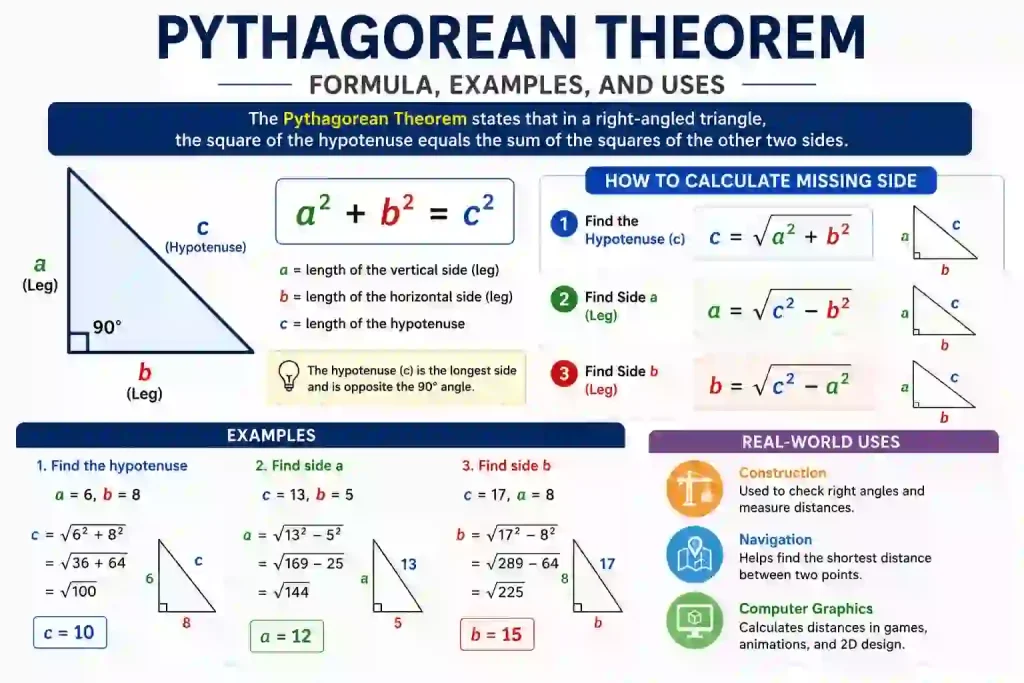
The Pythagorean Theorem is based on a simple relationship between the two legs and the hypotenuse of a right triangle.
The standard formula is:
a² + b² = c²
In this equation, a and b are the two legs of the triangle, while c is the hypotenuse.
This guide explains what the theorem means, how to use the formula, how to solve different types of problems, and where the Pythagorean Theorem is used in real life.
What Is the Pythagorean Theorem?
The Pythagorean Theorem states that the sum of the squares of the two legs of a right triangle is equal to the square of the hypotenuse.
The formula is:
a² + b² = c²
A right triangle is a triangle that contains one 90-degree angle.
The three sides have specific names:
- a = first leg
- b = second leg
- c = hypotenuse
The two legs meet at the 90-degree angle. The hypotenuse is opposite the right angle and is always the longest side.
For example, if the legs are 3 and 4, the hypotenuse is 5:
3² + 4² = 5²
9 + 16 = 25
25 = 25
Because both sides are equal, the relationship works.
Khan Academy also explains the theorem as the relationship between the side lengths of a right triangle and shows how it can be used to find missing side lengths.
Why Is the Pythagorean Theorem Important?
The theorem is important because it gives you a reliable way to calculate an unknown side of a right triangle.
Without it, many distance and measurement problems would require more complicated methods.
For example, imagine you know:
- One side = 6 meters
- Other side = 8 meters
- Diagonal = ?
You can use the Pythagorean Theorem to calculate the diagonal:
c = √(6² + 8²)
c = √(36 + 64)
c = √100
c = 10 meters
This makes the theorem useful for both academic and practical problems.
Understanding the Parts of a Right Triangle
Before using the formula, you need to know which side is which.
The Two Legs
The two shorter sides that form the 90-degree angle are called the legs.
They are usually represented by:
a and b
Their order does not matter. You can call either leg a or b.
The Hypotenuse
The hypotenuse is the side opposite the 90-degree angle.
It is represented by:
c
The hypotenuse is always the longest side of a right triangle.
A useful way to identify it is to find the right angle first and then look directly across from it.
The Pythagorean Theorem Formula
The basic formula is:
a² + b² = c²
This equation can be rearranged to solve for any missing side.
Formula for the Hypotenuse
When a and b are known:
c = √(a² + b²)
Formula for Side A
When c and b are known:
a = √(c² − b²)
Formula for Side B
When c and a are known:
b = √(c² − a²)
These three formulas allow you to calculate any missing side when the other two side lengths are known.
How to Use the Pythagorean Theorem
Solving a right-triangle problem usually follows a simple process.
Step 1: Confirm the Triangle Is a Right Triangle
The theorem applies specifically to triangles with a 90-degree angle.
Step 2: Identify the Hypotenuse
Find the side opposite the right angle.
Step 3: Identify the Known Values
Determine which two side lengths you already have.
Step 4: Choose the Correct Formula
Use the formula based on the side you need to find.
Step 5: Substitute the Values
Replace the variables with the numbers given in the problem.
Step 6: Perform the Calculation
Square the values, add or subtract as needed, and then take the square root.
Step 7: Check Your Answer
Make sure the result is reasonable and that the hypotenuse is longer than either leg.
Example 1: Finding the Hypotenuse
Suppose a right triangle has legs of:
a = 5
b = 12
Find c.
Start with:
a² + b² = c²
Substitute the values:
5² + 12² = c²
25 + 144 = c²
169 = c²
Take the square root:
c = √169
c = 13
Answer
The hypotenuse is 13 units.
Example 2: Finding a Missing Leg
Suppose a right triangle has:
c = 13
b = 5
Find a.
Use:
a = √(c² − b²)
Substitute the values:
a = √(13² − 5²)
a = √(169 − 25)
a = √144
a = 12
Answer
The missing leg is 12 units.
Example 3: Finding the Other Leg
Suppose:
c = 17
a = 8
Find b.
Use:
b = √(c² − a²)
Substitute:
b = √(17² − 8²)
b = √(289 − 64)
b = √225
b = 15
Answer
The missing side is 15 units.
Pythagorean Theorem Example With a Real-World Problem
Imagine a ladder leaning against a wall.
The ladder is 13 feet long, and the bottom of the ladder is 5 feet away from the wall.
The ladder creates a right triangle:
- Base = 5 feet
- Height = ?
- Hypotenuse = 13 feet
Use:
a = √(c² − b²)
Substitute:
a = √(13² − 5²)
a = √(169 − 25)
a = √144
a = 12
The ladder reaches 12 feet up the wall.
This is a common example of how the theorem can solve practical measurement problems.
Pythagorean Triples
A Pythagorean triple is a set of three positive whole numbers that satisfy:
a² + b² = c²
Some common Pythagorean triples are:
| Side A | Side B | Hypotenuse |
|---|---|---|
| 3 | 4 | 5 |
| 5 | 12 | 13 |
| 6 | 8 | 10 |
| 8 | 15 | 17 |
| 7 | 24 | 25 |
For example:
8² + 15² = 17²
64 + 225 = 289
289 = 289
Pythagorean triples can make some geometry problems much faster because you can recognize the relationship without performing a long calculation.
How to Find the Missing Side of a Right Triangle
The Pythagorean Theorem is especially useful when one side is missing.
If the Hypotenuse Is Missing
Use:
c = √(a² + b²)
Add the squares of the two legs, then take the square root.
If Side A Is Missing
Use:
a = √(c² − b²)
Subtract the square of the known leg from the square of the hypotenuse.
If Side B Is Missing
Use:
b = √(c² − a²)
Again, subtract the known leg’s square from the hypotenuse’s square.
Understanding which formula to use is often the most important part of solving the problem.
Common Pythagorean Theorem Mistakes
Even though the formula is simple, students often make a few common mistakes.
Using the Theorem on a Non-Right Triangle
The standard Pythagorean Theorem applies to right triangles.
Choosing the Wrong Hypotenuse
The hypotenuse is the side opposite the 90-degree angle.
Forgetting to Square the Side Lengths
The formula is:
a² + b² = c²
not:
a + b = c
Forgetting the Square Root
If:
c² = 144
then:
c = 12
The answer is not 144.
Adding Instead of Subtracting
When finding a missing leg, subtract the known leg’s square from the hypotenuse’s square.
Forgetting the Units
If your measurements are in centimeters, the final answer should also include centimeters.
How to Check Your Answer
A quick check can help you identify calculation mistakes.
Suppose your answer is:
a = 9
b = 12
c = 15
Substitute the values into the original formula:
9² + 12² = 15²
81 + 144 = 225
225 = 225
The two sides match, so the result is correct.
You can also check the size of the answer. The hypotenuse must be longer than either leg.
Real-Life Uses of the Pythagorean Theorem
The Pythagorean Theorem is not limited to classroom mathematics. It can be applied in many real-world situations.
Construction and Carpentry
Builders and carpenters can use right-triangle measurements to check whether corners are square.
The familiar 3-4-5 relationship is particularly useful for checking a 90-degree corner.
Architecture and Design
Architects and designers may work with diagonal measurements when planning layouts, structures, and spaces.
Navigation
The theorem can help determine direct distance when horizontal and vertical distances are known.
Coordinate Geometry
The distance formula is closely connected to the Pythagorean Theorem.
For two points:
(x₁, y₁) and (x₂, y₂)
the distance is:
d = √((x₂ − x₁)² + (y₂ − y₁)²)
The horizontal and vertical differences create the legs of a right triangle, while the direct distance acts as the hypotenuse.
Computer Graphics
The same relationship can be used to calculate distances between points in two-dimensional coordinate systems.
Sports and Recreation
The theorem can also help with diagonal measurements across courts, fields, rooms, and other rectangular spaces.
Pythagorean Theorem and the Distance Formula
The distance formula is essentially an application of the Pythagorean relationship.
Suppose two points have different horizontal and vertical positions. The horizontal difference becomes one leg, and the vertical difference becomes the other leg.
The straight-line distance between the two points is the hypotenuse.
This connection is why the Pythagorean Theorem appears in coordinate geometry and other areas involving distance calculations.
Pythagorean Theorem Calculator
When calculations become time-consuming, an online calculator can help you find a missing side quickly.
Our Pythagorean Theorem Calculator can be used when you know two sides of a right triangle and need to calculate the third.
A calculator is particularly helpful when:
- The numbers are large.
- The result includes decimals.
- You need to solve several problems.
- You want to check your manual calculation.
- You want a faster way to find the missing side.
For learning, it is still important to understand the formula rather than relying only on the final calculator result.
When Should You Not Use the Pythagorean Theorem?
The standard formula should not be used directly for every triangle.
If a triangle does not contain a 90-degree angle, you may need a different method.
For example, the Law of Cosines can be used for many non-right triangles, while the Law of Sines is useful in other situations involving known angles and sides.
The first question should always be:
Does the triangle have a 90-degree angle?
If the answer is no, the standard Pythagorean formula is not the correct starting point.
Why Does the Pythagorean Theorem Work?
The theorem is more than just a formula for finding missing sides. It describes a geometric relationship between squares built on the three sides of a right triangle.
The combined area of the squares constructed on the two legs is equal to the area of the square constructed on the hypotenuse.
That relationship can be represented by:
a² + b² = c²
This is the geometric idea behind the theorem and explains why squaring the side lengths is part of the calculation.
Frequently Asked Questions
What is the Pythagorean Theorem?
The Pythagorean Theorem is a mathematical rule that relates the three side lengths of a right triangle. It states:
a² + b² = c²
What is the formula for the Pythagorean Theorem?
The standard formula is:
a² + b² = c²
where a and b are the legs and c is the hypotenuse.
What is the hypotenuse?
The hypotenuse is the side opposite the 90-degree angle. It is also the longest side of a right triangle.
Can the Pythagorean Theorem be used on every triangle?
No. The standard theorem applies specifically to right triangles.
How do I find the hypotenuse?
Use:
c = √(a² + b²)
How do I find a missing leg?
Use one of these formulas:
a = √(c² − b²)
or:
b = √(c² − a²)
What is a 3-4-5 triangle?
A 3-4-5 triangle is a right triangle whose side lengths satisfy:
3² + 4² = 5²
9 + 16 = 25
It is one of the most common Pythagorean triples.
Why is the Pythagorean Theorem useful?
It can help you find missing side lengths, calculate direct distances, check right angles, solve geometry problems, and work with practical measurements.
Conclusion
The Pythagorean Theorem provides one of the simplest and most useful relationships in geometry. By understanding the formula:
a² + b² = c²
you can calculate a missing side of a right triangle, verify measurements, and solve many practical distance problems.
The key is to identify the right angle, find the hypotenuse, choose the correct formula, and check your final answer.
Whether you are a student learning geometry, a teacher preparing examples, or someone working with real-world measurements, understanding the Pythagorean Theorem gives you a valuable mathematical tool.
When you need to calculate a missing side quickly, use our Pythagorean Theorem Calculator to check your result.
For additional explanations and practice, explore Khan Academy’s Pythagorean theorem resources.