
Understanding geometry does not have to be complicated. Whether you are studying for a math test, working on a school assignment, planning a carpentry project, or calculating a direct distance, knowing how to solve a right triangle is an important mathematical skill.
Instead of calculating square roots manually every time, a reliable Pythagorean Theorem Calc can help you find a missing side quickly and accurately. It can also make it easier to check your work and understand each step of the calculation.
In this guide, you will learn how the Pythagorean theorem works, how to find each missing side, how to use a Pythagorean Theorem Calc, and where this formula is useful in real-world situations.
What Is the Pythagorean Theorem?
The Pythagorean theorem is a fundamental rule in geometry that describes the relationship between the three sides of a right triangle.
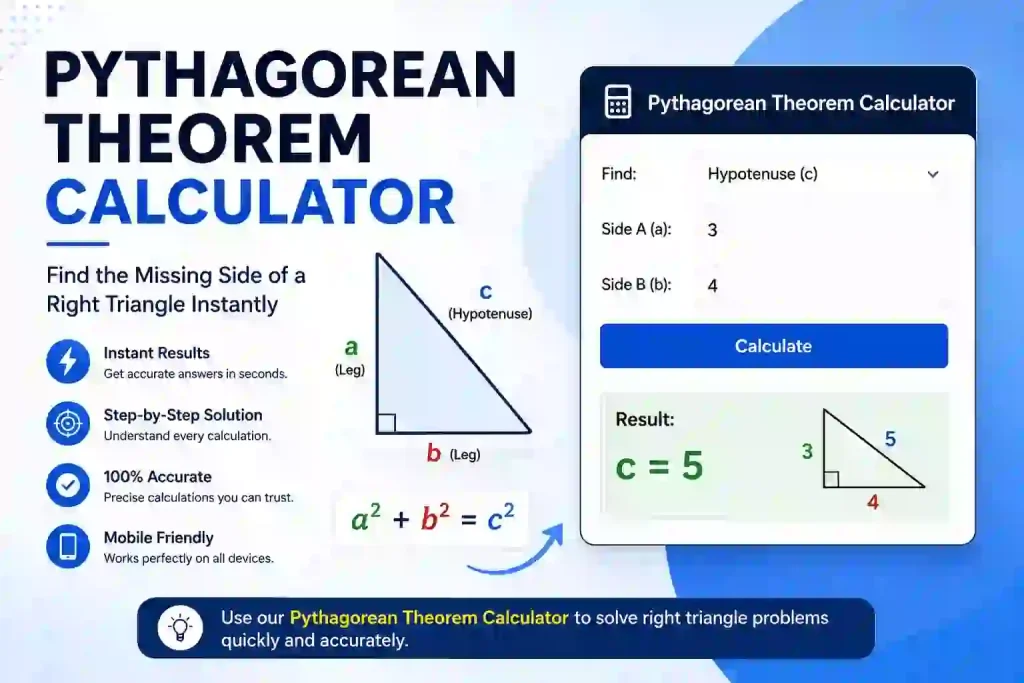
A right triangle contains one angle measuring 90 degrees. The side opposite that right angle is called the hypotenuse, while the other two sides are called the legs.
The standard formula is:
a² + b² = c²
Where:
- a = first leg
- b = second leg
- c = hypotenuse
The hypotenuse is always the longest side of a right triangle because it is opposite the 90-degree angle.
A Pythagorean Theorem Calc uses this relationship to determine the unknown side when two side lengths are known.
How Does a Pythagorean Theorem Calc Work?
A Pythagorean Theorem Calc takes the side lengths you provide and applies the correct version of the Pythagorean theorem.
Depending on which side is missing, you can use one of three formulas.
Finding the Hypotenuse
When both legs are known, use:
c = √(a² + b²)
For example, suppose:
- a = 6 cm
- b = 8 cm
First, square both legs:
6² = 36
8² = 64
Then add the values:
36 + 64 = 100
Finally, take the square root:
c = √100
c = 10 cm
The hypotenuse is 10 cm.
Finding Side A
When the hypotenuse and side b are known, use:
a = √(c² − b²)
For example:
- c = 13 feet
- b = 5 feet
Square the known values:
13² = 169
5² = 25
Subtract:
169 − 25 = 144
Take the square root:
a = √144
a = 12 feet
The missing side is 12 feet.
Finding Side B
When the hypotenuse and side a are known, use:
b = √(c² − a²)
For example:
- c = 17 units
- a = 8 units
Then:
b = √(17² − 8²)
b = √(289 − 64)
b = √225
b = 15 units
The missing side is 15 units.
How to Solve a Right Triangle Step-by-Step
You can solve most basic right-triangle problems by following the same process.
Step 1: Identify the Right Angle
First, make sure the triangle contains a 90-degree angle. The Pythagorean theorem is specifically used for right triangles.
Step 2: Identify the Hypotenuse
Find the side opposite the 90-degree angle. This is the hypotenuse and should be the longest side.
Step 3: Write Down the Known Values
Identify which two side lengths are already given.
For example:
a = 9
b = 12
c = ?
Step 4: Choose the Correct Formula
If the hypotenuse is missing:
c = √(a² + b²)
If side a is missing:
a = √(c² − b²)
If side b is missing:
b = √(c² − a²)
Step 5: Substitute the Values
Replace the variables with the measurements from the problem.
Step 6: Calculate Carefully
Square the required values, perform the addition or subtraction, and then take the square root.
Step 7: Check the Answer
Make sure your result is reasonable and that the hypotenuse is longer than either leg.
You can also substitute the answer back into:
a² + b² = c²
to verify the result.
Why Use an Online Pythagorean Theorem Calc?
Simple combinations such as 3, 4, and 5 are easy to calculate manually. However, real problems often contain decimals, larger numbers, or square roots that are not perfect squares.
A Pythagorean Theorem Calc can make these calculations faster and easier.
Instant Results
The calculator performs the arithmetic quickly, which can save time when you are solving several problems.
Fewer Arithmetic Errors
Manual calculations can lead to mistakes when squaring numbers, subtracting values, or calculating square roots. A calculator helps reduce these errors.
Easy to Use for Different Missing Sides
A good calculator can help you find side a, side b, or the hypotenuse without requiring you to rearrange the formula manually every time.
Useful for Learning
A step-by-step calculator can do more than display an answer. It can help you understand how the formula is applied and how each value is calculated.
Helpful for Checking Homework
Students can solve a problem manually first and then use the calculator to verify the final result.
Example: Solving a Right Triangle With a Pythagorean Theorem Calc
Suppose a right triangle has:
- Side a = 8
- Side b = 15
- Hypotenuse = ?
Use:
c = √(a² + b²)
Substitute the values:
c = √(8² + 15²)
c = √(64 + 225)
c = √289
c = 17
The hypotenuse is 17 units.
You can enter the same values into a Pythagorean Theorem Calc to quickly confirm the answer.
Understanding Pythagorean Triples
A Pythagorean triple is a group of three positive integers that satisfy the Pythagorean theorem.
Some common examples include:
3, 4, 5
3² + 4² = 5²
9 + 16 = 25
5, 12, 13
5² + 12² = 13²
25 + 144 = 169
8, 15, 17
8² + 15² = 17²
64 + 225 = 289
7, 24, 25
7² + 24² = 25²
49 + 576 = 625
These triples can be useful when solving geometry problems because they provide familiar side relationships.
Multiples of a Pythagorean triple also work. For example, multiplying 3, 4, and 5 by 2 gives:
6, 8, 10
and:
6² + 8² = 10²
36 + 64 = 100
Real-World Applications of the Pythagorean Theorem
The Pythagorean theorem is useful far beyond classroom exercises. It can help calculate distances, diagonals, and measurements in many practical situations.
Construction and Carpentry
Builders and carpenters can use the well-known 3-4-5 relationship to check whether a corner is square.
For example, if one measurement is 3 feet and another is 4 feet, the diagonal should measure 5 feet for a perfect right angle.
This simple technique can help with framing, layouts, flooring, and other construction tasks.
TV and Monitor Screen Sizes
The advertised size of a television or monitor is measured diagonally.
If the screen width and height are known, the Pythagorean theorem can be used to calculate the diagonal distance.
In this case:
- Width = one leg
- Height = the other leg
- Diagonal = hypotenuse
Navigation and Mapping
The relationship between horizontal and vertical movement can be used to determine direct distance.
For example, moving a certain distance east and another distance north creates the legs of a right triangle, while the straight-line distance becomes the hypotenuse.
Coordinate Geometry
The distance formula in coordinate geometry is closely related to the Pythagorean theorem.
For two points:
(x₁, y₁) and (x₂, y₂)
the distance formula is:
d = √((x₂ − x₁)² + (y₂ − y₁)²)
The horizontal and vertical differences form the two legs of a right triangle, while the distance between the points represents the hypotenuse.
Common Mistakes When Using a Pythagorean Theorem Calc
Even when using an online calculator, it is important to enter the correct information.
Choosing the Wrong Hypotenuse
The hypotenuse is always opposite the 90-degree angle.
Using the Formula on the Wrong Triangle
The standard Pythagorean theorem applies to right triangles, not every type of triangle.
Forgetting to Square the Values
The formula uses squared side lengths.
Incorrect:
a + b = c
Correct:
a² + b² = c²
Forgetting the Square Root
If you get:
c² = 100
you still need to calculate:
c = √100
c = 10
Using Addition Instead of Subtraction
When finding a missing leg, subtract the known leg squared from the hypotenuse squared.
Correct:
a = √(c² − b²)
Entering Values in the Wrong Fields
Always make sure the side lengths are entered into the correct calculator fields.
How to Verify Your Answer
Checking your result is a simple but important step.
Suppose you have:
a = 7
b = 24
c = 25
Substitute the values into the original formula:
7² + 24² = 25²
49 + 576 = 625
625 = 625
Because both sides are equal, the result is correct.
You can also use a Pythagorean Theorem Calc to compare your manual calculation with the calculator result.
Can a Pythagorean Theorem Calc Solve Every Triangle?
No. The standard Pythagorean theorem applies specifically to right triangles.
If a triangle does not have a 90-degree angle, you may need another method, such as the Law of Cosines or the Law of Sines, depending on the information provided.
This distinction is important because entering inappropriate values into a calculator can lead to an invalid result.
Frequently Asked Questions
What is a Pythagorean Theorem Calc?
A Pythagorean Theorem Calc is an online tool that uses the Pythagorean theorem to calculate a missing side of a right triangle.
What is the basic Pythagorean theorem formula?
The basic formula is:
a² + b² = c²
Here, a and b are the legs, while c is the hypotenuse.
What is the hypotenuse?
The hypotenuse is the longest side of a right triangle. It is located opposite the 90-degree angle.
How do I find the missing side without a calculator?
You can solve the problem manually by identifying the known sides, selecting the correct formula, substituting the values, and taking the square root when necessary.
Can I use a Pythagorean Theorem Calc for decimals?
Yes. An online calculator can be especially useful when the side lengths are decimals or when the result is not a whole number.
Is the 3-4-5 triangle a Pythagorean triple?
Yes. The numbers 3, 4, and 5 satisfy:
3² + 4² = 5²
9 + 16 = 25
How do I know which formula to use?
Use:
c = √(a² + b²) when finding the hypotenuse.
Use:
a = √(c² − b²) when finding side a.
Use:
b = √(c² − a²) when finding side b.
Summary
The Pythagorean theorem is one of the most useful tools for solving right triangles. Its core relationship is:
a² + b² = c²
Once you know which side is the hypotenuse and which two values are available, you can rearrange the formula to find the missing side.
A reliable Pythagorean Theorem Calc can make the process faster, reduce arithmetic mistakes, and help you verify your work. It is useful for students, teachers, construction projects, geometry practice, and real-world distance calculations.
When you need to solve a right triangle quickly, use our Pythagorean Theorem Calculator to find the missing side and check your calculation.
For additional learning, you can also explore trusted educational resources about the Pythagorean theorem and right triangles.