
Real-life math challenges often come disguised as word problems. Whether you are finding the direct distance across a park, measuring the height of a building, or setting up a ladder safely, Pythagorean Theorem word problems are designed to test how well you apply geometry to real-world scenarios. By converting visual geometry into algebraic equations ($a^2 + b^2 = c^2$), these practical exercises bridge the gap between classroom theory and real-world problem-solving.
Why Are Pythagorean Theorem Word Problems Important?
Solving Pythagorean Theorem word problems helps students and professionals build spatial reasoning and critical thinking skills. You encounter these concepts in everyday life without even realizing it:
Sports & Tech: Measuring screen sizes (which are calculated diagonally) or calculating field distances in baseball and football.
Navigation & Construction: Finding the shortest path across a field or calculating diagonal measurements in framing and architecture.
Safety & Accessibility: Calculating the correct angle and length for ladders or wheelchair ramps.
In this guide, we break down the formula, outline a 4-step framework to tackle any problem, and walk through practical examples step-by-step.
Step-by-Step Guide to Solve Any Problem
When facing complex Pythagorean Theorem word problems, follow this 4-step framework to get the correct answer every time:
- Draw a Diagram: Visualizing the right triangle is 80% of the work. Identify the 90-degree angle first.
- Identify the Legs and Hypotenuse:
- Legs ($a$ and $b$): The two sides forming the right angle (e.g., ground distance, wall height).
- Hypotenuse ($c$): The longest side directly opposite the right angle (e.g., ladder length, diagonal path).
- Set Up the Formula: Plug the known values into $a^2 + b^2 = c^2$.
- Solve for the Unknown: Take the square root of both sides to find the final distance.
Real-Life Examples with Solutions
Example 1: The Ladder Safety Problem
A 13-foot ladder is leaning against a vertical wall. The base of the ladder is placed 5 feet away from the wall. How high up the wall does the ladder reach?
- Given: Hypotenuse ($c$) = 13 ft, Base leg ($a$) = 5 ft
- Equation: $5^2 + b^2 = 13^2$
- Calculation:$$25 + b^2 = 169$$$$b^2 = 169 – 25 = 144$$$$b = \sqrt{144} = 12 \text{ feet}$$
- Answer: The ladder reaches 12 feet up the wall.
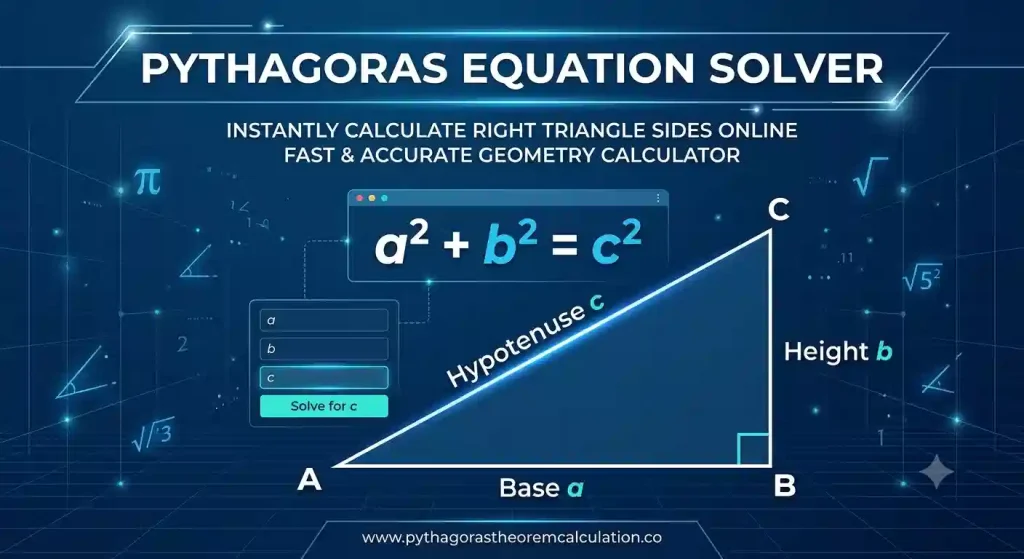
Online Pythagoras Equation Solver: Fast & Accurate Geometry Tool
Calculating missing sides of a right-angled triangle doesn’t have to involve tedious manual square roots and algebraic steps. Our digital Pythagoras Equation Solver simplifies complex geometry calculations into a single click.
Whether you need to find the hypotenuse ($c$), height ($b$), or base ($a$), this online tool processes your inputs instantly and gives accurate results every time.
How to Use the Pythagoras Equation Solver Tool
- Select the Missing Side: Choose whether you want to solve for Hypotenuse ($c$), Base ($a$), or Height ($b$).
- Enter Known Values: Type in the lengths of the two known sides into the input fields.
- Click Solve: Hit the “Solve for c” (or $a$/$b$) button to view your instant, step-by-step mathematical breakdown.
The Core Pythagorean Theorem Formula
Every right-angled triangle problem relies on one fundamental formula:
$$a^2 + b^2 = c^2$$
- $a$ = Base / Horizontal Distance
- $b$ = Height / Vertical Distance
- $c$ = Hypotenuse (The diagonal line opposite the $90^\circ$ angle)
When solving pythagorean-theorem-word-problems, your main goal is to identify which two values are provided and solve for the missing third side.
4 Steps to Solve Any Pythagorean Word Problem
Follow this universal strategy to convert tricky word problems into simple math:
- Draw a Diagram: Sketch a right-angled triangle based on the story.
- Label the Sides: Assign the given numbers to $a$, $b$, or $c$. Remember: the longest distance or diagonal is always $c$.
- Plug Numbers into the Formula: Substitute your values into $a^2 + b^2 = c^2$.
- Calculate the Result: Solve for the missing variable using square roots.
💡 Need Fast Results? If you are working with large numbers or complex decimals, skip manual calculations and use our free Pythagoras Equation Solver for instant, accurate answers!
Real-World Examples & Step-by-Step Solutions
Example 1: The Directional Walking Problem
Problem:
A person walks $48\text{ feet}$ East, turns $90^\circ$ North, and walks $20\text{ feet}$. What is the direct distance from the starting point to the end point?
Solution:
- Base ($a$) = $48\text{ ft}$
- Height ($b$) = $20\text{ ft}$
- Hypotenuse ($c$) = Unknown
$$a^2 + b^2 = c^2$$
$$(48)^2 + (20)^2 = c^2$$
$$2304 + 400 = c^2$$
$$2704 = c^2$$
$$c = \sqrt{2704} = 52\text{ ft}$$
Answer: The direct distance back to the start is $52\text{ feet}$.
Example 2: The Leaning Ladder Problem
Problem:
A $13\text{-foot}$ ladder reaches a window on a vertical wall. If the bottom of the ladder is placed $5\text{ feet}$ away from the base of the wall, how high up is the window?
Solution:
- Base ($a$) = $5\text{ ft}$
- Hypotenuse ($c$) = $13\text{ ft}$ (Ladder length)
- Height ($b$) = Unknown
$$a^2 + b^2 = c^2$$
$$5^2 + b^2 = 13^2$$
$$25 + b^2 = 169$$
$$b^2 = 169 – 25$$
$$b^2 = 144$$
$$b = \sqrt{144} = 12\text{ ft}$$
Answer: The window is $12\text{ feet}$ high.
Common Pythagorean Triplets to Memorize
To solve pythagorean-theorem-word-problems quickly in exams without heavy calculations, keep these common triplets in mind:
- $(3, 4, 5)$
- $(5, 12, 13)$
- $(8, 15, 17)$
- $(7, 24, 25)$
Frequently Asked Questions (FAQs)
How do I know if a word problem uses the Pythagorean Theorem?
Look for indicators like $90^\circ$ turns, directions (North/South paired with East/West), leaning objects like ladders or shadows, or finding the shortest diagonal path across a rectangular field.
Can I solve word problems if the hypotenuse is given?
Yes! Simply rearrange the equation:
- To find Height ($b$): $b = \sqrt{c^2 – a^2}$
- To find Base ($a$): $a = \sqrt{c^2 – b^2}$
Conclusion
Mastering Pythagorean Theorem word problems becomes remarkably straightforward once you learn to break down any real-world scenario into a right triangle. Whether you are measuring diagonal distances, setting up construction scaffolding, or solving classic textbook challenges, translating word descriptions into the simple formula $a^2 + b^2 = c^2$ eliminates confusion and ensures accurate results every time.
By regularly practicing Pythagorean Theorem word problems, you build strong geometric intuition and spatial reasoning skills that apply far beyond the classroom. Always remember the essential steps: draw a quick sketch, correctly identify the hypotenuse opposite the right angle, keep your units consistent, and take the square root at the very end.
Need to check your work or solve a complex geometry problem on the fly? For fast homework checking, instant step-by-step verification, and error-free results, head over to Pythagoras Theorem Calculator to solve your geometry equations in seconds!