
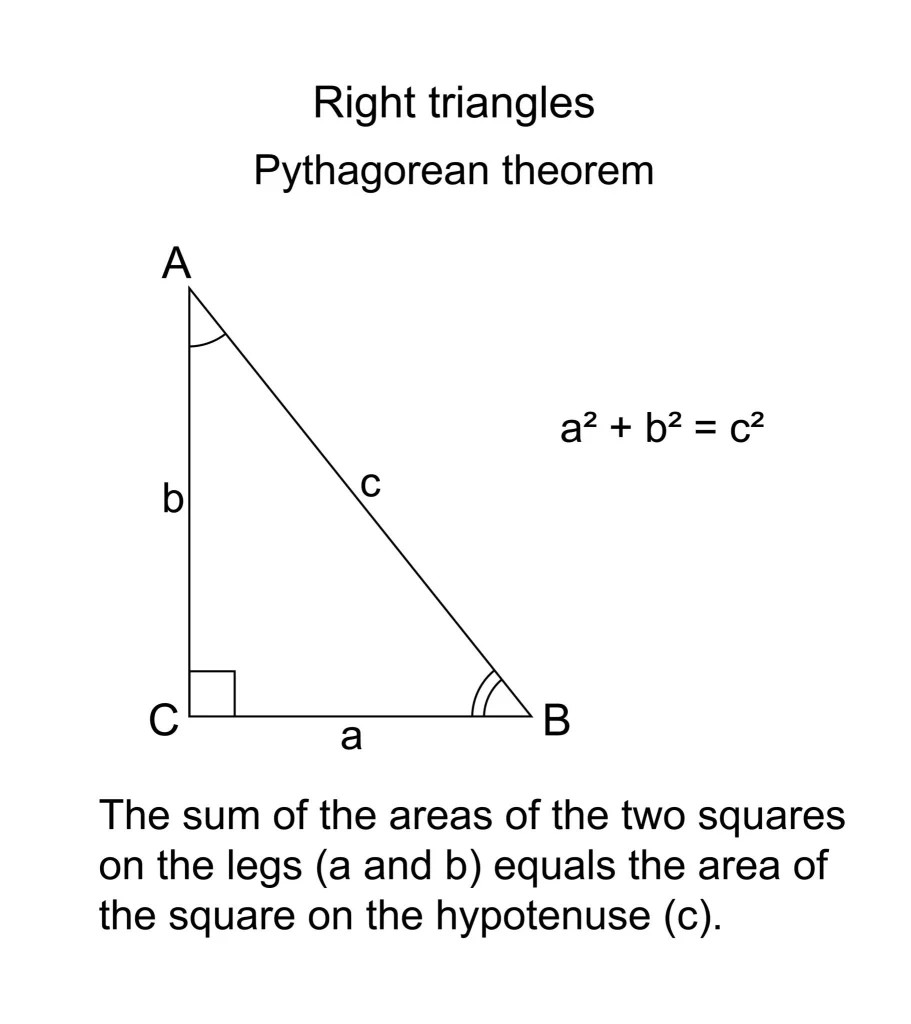
If you have ever worked with right-angled triangles, you already know the famous Pythagorean theorem: a² + b² = c². However, working with decimals or square roots can get messy very quickly. This is where a pythagorean triple makes geometry much simpler.
A pythagorean triple consists of three positive integers (a, b, c) that fit the Pythagorean equation perfectly. Instead of dealing with fractional measurements or irrational numbers, these whole-number sets give you exact dimensions for a right triangle.
What Makes a Set a Pythagorean Triple?
For any three positive whole numbers to form a pythagorean triple, they must satisfy one condition: the sum of the squares of the two smaller numbers must equal the square of the largest number (the hypotenuse).
Mathematically, the relationship is written as:
a² + b² = c²
Where:
- a and b are the shorter legs of the right triangle.
- c is the hypotenuse (the longest side).
The Classic (3, 4, 5) Example
The most common pythagorean triple taught in math classes is (3, 4, 5).
Here is how you check it step-by-step:
- Step 1: Square the first side (a = 3)3² = 9
- Step 2: Square the second side (b = 4)4² = 16
- Step 3: Add the two squared numbers together9 + 16 = 25
- Step 4: Square the longest side (c = 5)5² = 25
Since 9 + 16 = 25, the set (3, 4, 5) forms a valid right triangle without any decimal rounding.
Resources and Tools
To learn more about right triangle geometry and test your measurements, check out this complete Pythagorean theorem guide with formula cheat sheet and online calculator. It includes quick reference formulas, step-by-step problem breakdowns, and visual diagrams to help you master triangle calculations easily.
Primitive vs. Non-Primitive Pythagorean Triples
Not all integer sets are built the same way. Geometers split every pythagorean triple into two main types:
1. Primitive Triples
A primitive pythagorean triple consists of three integers that share no common factors other than 1. In formal terms, their greatest common divisor is 1: gcd(a, b, c) = 1.
- Examples: (3, 4, 5), (5, 12, 13), and (8, 15, 17).
2. Non-Primitive Triples
You can create a non-primitive pythagorean triple simply by multiplying an existing primitive set by any positive whole number (k).
For instance, if you take (3, 4, 5) and multiply each number by 2, you get (6, 8, 10):
6² + 8² = 36 + 64 = 100
10² = 100
Because (6, 8, 10) shares a common factor of 2, it is non-primitive, but it still forms a valid right triangle.
How to Generate Any Pythagorean Triple Using Euclid’s Formula
Instead of guessing random numbers, you can generate an infinite number of primitive sets using Euclid’s Formula.
Follow these steps to generate a triple:
- Step 1: Pick two positive integers, m and n, where:
- m > n > 0
- m and n share no common factors (gcd(m, n) = 1)
- One number is even, and the other is odd
- Step 2: Calculate side a using the formula:a = m² – n²
- Step 3: Calculate side b using the formula:b = 2mn
- Step 4: Calculate hypotenuse c using the formula:c = m² + n²
Example Calculation (Let m = 3 and n = 2)
- Step 1 (Side a): 3² – 2² = 9 – 4 = 5
- Step 2 (Side b): 2 * 3 * 2 = 12
- Step 3 (Side c): 3² + 2² = 9 + 4 = 13
This gives us the primitive pythagorean triple (5, 12, 13).
List of Common Pythagorean Triples
Memorizing a few standard sets saves time on exams, construction projects, and fast mental calculations.
| Side a | Side b | Hypotenuse (c) | Formula Check (a² + b² = c²) | Type |
| 3 | 4 | 5 | 9 + 16 = 25 | Primitive |
| 5 | 12 | 13 | 25 + 144 = 169 | Primitive |
| 6 | 8 | 10 | 36 + 64 = 100 | Non-Primitive |
| 8 | 15 | 17 | 64 + 225 = 289 | Primitive |
| 7 | 24 | 25 | 49 + 576 = 625 | Primitive |
| 9 | 40 | 41 | 81 + 1600 = 1681 | Primitive |
Real-World Applications
A pythagorean triple isn’t just an abstract math concept—it has everyday practical uses:
- Construction and Carpentry: Builders use the 3-4-5 method to ensure walls meet at an exact 90° angle. They measure 3 feet on one wall, 4 feet on another, and adjust until the diagonal distance is exactly 5 feet to guarantee a square corner.
- Computer Graphics: Game developers use these exact integer ratios to calculate 2D spatial distances and collision boxes quickly without extra processing power.
- Navigation and Mapping: GPS mapping tools rely on integer coordinate triangulation to calculate flat distances rapidly.
Understanding how a pythagorean triple works gives you a quick shortcut for solving spatial problems without relying on a calculator every time.