
Mathematical calculations, especially geometry, can be time-consuming and confusing without the right tools. When it comes to finding the missing sides of a right-angled triangle, the Pythagoras Theorem is the fundamental concept we rely on.
However, calculating complex square roots manually isn’t ideal for every problem. That’s where the Pythagoras Equation Solver comes in handy to save your time and give instant, accurate results.
In this detailed guide, we will explore how a Pythagoras Equation Solver works, the core formula behind it, and how you can seamlessly calculate missing triangle sides on https://pythagorastheoremcalculation.co/.
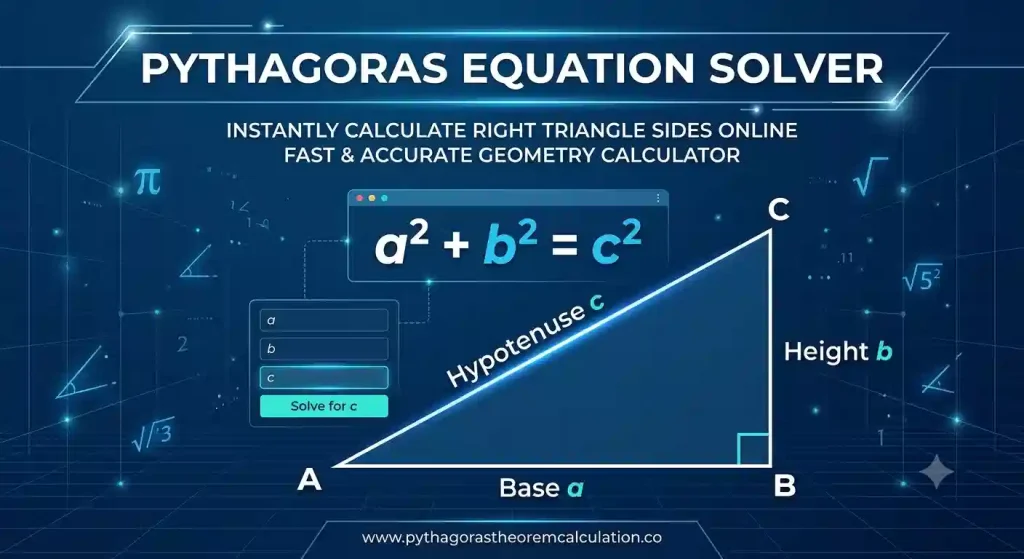
What is the Pythagoras Theorem?
The Pythagoras Theorem is one of the most fundamental rules in geometry. It states that:
“In any right-angled triangle (a triangle with one $90^\circ$ angle), the square of the hypotenuse is equal to the sum of the squares of the other two sides.”
Mathematical Formula:
$$a^2 + b^2 = c^2$$
Where:
- $a$ = Base
- $b$ = Perpendicular / Height
- $c$ = Hypotenuse (the longest side opposite to the $90^\circ$ angle)
If you need to find the hypotenuse ($c$), the equation simplifies to:
$$c = \sqrt{a^2 + b^2}$$
To find one of the leg sides ($a$ or $b$):
$$a = \sqrt{c^2 – b^2}$$
$$b = \sqrt{c^2 – a^2}$$
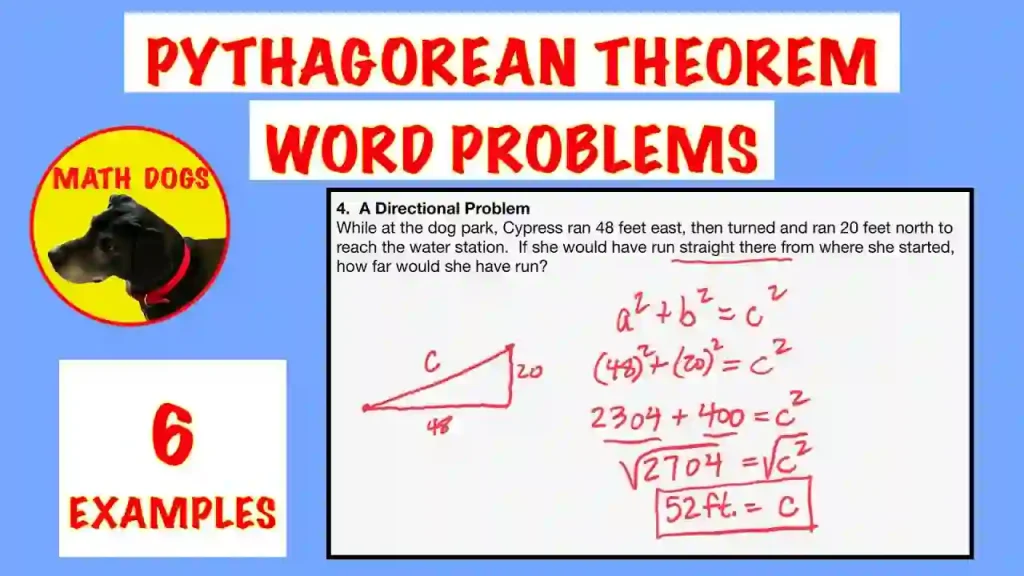
Solving Pythagorean Theorem Word Problems (Step-by-Step Example)
Understanding how to solve geometry word problems becomes extremely easy when you break down the directional movements into a right-angled triangle layout.
Let’s look at a practical directional problem solved step-by-step:
Example Problem:
“While at the dog park, Cypress ran 48 feet east, then turned and ran 20 feet north to reach the water station. If she had run straight there from where she started, how far would she have run?”
Step-by-Step Solution Breakdown:
- Identify the Given Values:
- East movement (Base $a$): $48\text{ feet}$
- North movement (Height $b$): $20\text{ feet}$
- Straight line distance (Hypotenuse $c$): Unknown ($c$)
- Apply the Pythagorean Formula:$$a^2 + b^2 = c^2$$
- Substitute the Values:$$(48)^2 + (20)^2 = c^2$$$$2304 + 400 = c^2$$$$2704 = c^2$$
- Calculate Square Root:$$c = \sqrt{2704}$$$$\mathbf{c = 52\text{ feet}}$$
Result: The direct distance Cypress ran is 52 feet.
💡 Pro Tip: Instead of doing manual square calculations like $48^2 = 2304$ and finding complex square roots, you can use an online Pythagoras Equation Solver to get instant answers for any word problem or real-world directional scenario in just one click!
Why Use an Online Pythagoras Equation Solver?
Manual calculations leave room for human error, especially when working with non-integer numbers or decimals. Using an online tool like Pythagoras Equation Solver provides several distinct benefits:
- Instant & Accurate Results: Eliminates calculation errors and produces answers within milliseconds.
- Step-by-Step Breakdown: Helps students understand how the answer was derived, making it a great learning tool.
- Saves Time: Ideal for students, geometry teachers, architects, engineers, and carpenters.
- 100% Free & Accessible: No sign-ups or downloads required.
You can directly head over to the Pythagoras Theorem Calculation Tool to compute missing triangle values effortlessly.
How to Use the Pythagoras Equation Solver (Step-by-Step)
Using the solver is straightforward:
- Visit pythagorastheoremcalculation.co.
- Enter the values for the two sides you already know (e.g., Base $a$ and Height $b$, or Hypotenuse $c$ and Base $a$).
- Click the “Calculate” button.
- The tool instantly calculates the missing side and provides a complete formula breakdown.
Real-Life Applications of the Pythagoras Theorem
The Pythagorean equation isn’t just limited to math textbooks; it plays an essential role in various real-world fields:
- Architecture & Construction: Builders use the 3-4-5 rule derived from this theorem to ensure corners are perfectly square ($90^\circ$).
- Navigation & GPS Tracking: Calculating shortest paths and triangular distances relies heavily on 2D/3D coordinate geometry.
- Computer Graphics & Game Development: Game engines use the distance formula (derived from Pythagoras) to calculate the spatial gap between two objects on a screen.
Frequently Asked Questions (FAQs)
1. Does the Pythagoras Theorem apply to all triangles?
No, the Pythagoras Theorem applies only to right-angled triangles where one angle is exactly $90^\circ$.
2. How do I identify the hypotenuse?
The hypotenuse is always the side directly opposite the $90^\circ$ right angle. It is also the longest side of the triangle.
3. What are Pythagorean Triplets?
Pythagorean triplets are sets of three positive integers $(a, b, c)$ that satisfy $a^2 + b^2 = c^2$. Common examples include $(3, 4, 5)$, $(5, 12, 13)$, and $(8, 15, 17)$.
Conclusion
Whether you are a student solving geometry homework, a teacher designing test problems, or a professional doing layout measurements, an online Pythagoras Equation Solver makes calculations quick and error-free.
Simplify your geometry work today by visiting https://pythagorastheoremcalculation.co/!