
A Pythagorean Theorem Calculator makes it easy to find a missing side of a right triangle without performing lengthy calculations manually. The Pythagorean Theorem is one of the most important formulas in geometry and is used to calculate the relationship between the three sides of a right-angled triangle.
The basic formula is:
a² + b² = c²
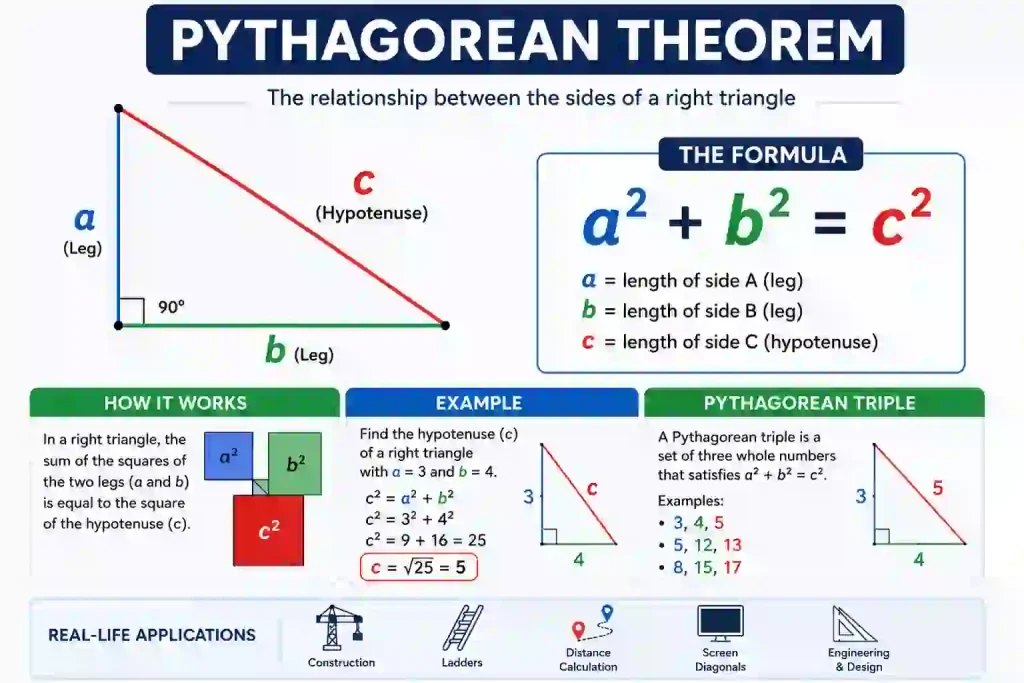
In this formula, a and b represent the two legs of a right triangle, while c represents the hypotenuse. The hypotenuse is always the longest side and is located opposite the 90-degree angle.
If you want a quick result, you can use our Pythagorean Theorem Calculator to calculate the missing side and check the solution.
What Is the Pythagorean Theorem?
The Pythagorean Theorem explains the relationship between the sides of a right triangle. It states that the sum of the squares of the two shorter sides is equal to the square of the hypotenuse.
The formula is:
a² + b² = c²
For example, suppose a right triangle has two known sides:
- Side A = 3
- Side B = 4
To find the hypotenuse:
c² = 3² + 4²
c² = 9 + 16
c² = 25
Now take the square root:
c = 5
Therefore, the hypotenuse is 5 units.
This is known as the famous 3-4-5 Pythagorean triple.
How to Calculate the Missing Hypotenuse
When both legs of a right triangle are known, you can calculate the hypotenuse by using:
c = √(a² + b²)
For example, imagine that:
- Side A = 6
- Side B = 8
First, square both sides:
6² = 36
8² = 64
Then add them:
36 + 64 = 100
Finally, calculate the square root:
√100 = 10
Therefore:
c = 10
The missing hypotenuse is 10 units.
Instead of calculating every step manually, you can enter the known measurements into a Pythagorean Theorem Calculator and get the answer quickly.
How to Find a Missing Side of a Right Triangle
The Pythagorean Theorem can also be used when the hypotenuse and one leg are known.
To find Side A, use:
a = √(c² – b²)
To find Side B, use:
b = √(c² – a²)
For example, suppose the hypotenuse is 13 units and one leg is 5 units.
Use the formula:
b = √(13² – 5²)
Calculate the squares:
13² = 169
5² = 25
Subtract:
169 – 25 = 144
Then take the square root:
√144 = 12
Therefore, the missing side is 12 units.
This gives us another well-known Pythagorean triple:
5, 12, 13
Why Use a Pythagorean Theorem Calculator?
Learning the Pythagorean Theorem manually is important, but an online calculator can save time when you need to solve several problems.
A dedicated calculator can help you:
- Find the missing hypotenuse
- Calculate a missing leg
- Check homework answers
- Verify manual calculations
- Work with decimal measurements
- Understand the calculation process
- Get results quickly
- Reduce common arithmetic mistakes
Our calculator is designed specifically for right-triangle calculations, so you can enter the known measurements and find the missing side.
Calculator.net and Other Online Calculator Tools
There are many online calculator websites that provide tools for different types of mathematical problems. Calculator.net is one example of a general calculator resource that offers calculators for mathematics, finance, health, fitness, and other everyday calculations.
A general calculator can be useful when you need to perform different types of calculations. However, when your main goal is to solve a right-triangle problem, a dedicated Pythagorean Theorem Calculator can make the process more straightforward.
With a specialized calculator, you do not have to manually rearrange the formula every time. You can focus on entering the correct measurements and understanding the result.
Pythagorean Theorem Calculator vs. General Calculator
A general calculator is useful for basic operations such as addition, subtraction, multiplication, division, and square roots.
However, solving a Pythagorean Theorem problem requires more than basic arithmetic. You need to identify the hypotenuse, select the correct formula, and enter the values correctly.
A dedicated Pythagorean calculator is designed specifically for this purpose.
| Feature | Pythagorean Theorem Calculator | General Calculator |
|---|---|---|
| Find hypotenuse | Yes | Requires manual formula |
| Find missing leg | Yes | Requires manual formula |
| Right-triangle calculations | Yes | Limited |
| Formula guidance | Yes | Usually no |
| Step-by-step solution | Can be provided | Usually no |
| Basic arithmetic | Yes | Yes |
For students and anyone working with right triangles, a dedicated calculator can make the calculation process easier to understand.
Real-Life Applications of the Pythagorean Theorem
The Pythagorean Theorem is not only used in school mathematics. It can also be applied to practical problems involving distance, height, width, and diagonal measurements.
Construction
Builders can use right-triangle calculations to determine diagonal distances, check measurements, and work with structures that contain right angles.
Architecture and Design
Architects and designers can use the theorem when calculating dimensions and diagonal distances in layouts and structures.
Distance Calculations
If you know the horizontal and vertical distance between two points, the Pythagorean Theorem can help determine the straight-line distance.
Screen Diagonal
The diagonal measurement of a rectangular screen can be calculated when its width and height are known.
For example:
Diagonal = √(width² + height²)
Engineering
Engineers use geometric calculations in many areas of design and construction. The Pythagorean relationship can be useful whenever two perpendicular measurements form a right triangle.
Common Pythagorean Triples
Pythagorean triples are sets of three positive integers that satisfy the Pythagorean Theorem.
Some common examples include:
- 3, 4, 5
- 5, 12, 13
- 8, 15, 17
- 7, 24, 25
- 20, 21, 29
For example:
3² + 4² = 5²
9 + 16 = 25
Therefore, 3, 4, and 5 form a Pythagorean triple.
Another example is:
5² + 12² = 13²
25 + 144 = 169
So, 5, 12, and 13 also form a Pythagorean triple.
How to Use a Pythagorean Theorem Calculator
Using an online calculator is simple.
Step 1: Identify the Right Triangle
Make sure the triangle contains a 90-degree angle. The Pythagorean Theorem applies specifically to right triangles.
Step 2: Identify the Known Measurements
Determine which sides are already known. Remember that the hypotenuse is always opposite the right angle.
Step 3: Enter the Values
Enter the known side measurements into the appropriate fields of the calculator.
Step 4: Calculate
Select the side you want to find and start the calculation.
Step 5: Check the Result
Review the final answer and, when available, check the calculation steps to understand how the result was obtained.
Our Pythagorean Theorem Calculator can be used to make these calculations faster and easier.
Common Mistakes When Using the Pythagorean Theorem
Although the formula is simple, some common mistakes can lead to incorrect results.
Using the Formula on a Non-Right Triangle
The standard Pythagorean Theorem is designed for right-angled triangles. Make sure the triangle has a 90-degree angle.
Identifying the Wrong Hypotenuse
The hypotenuse is always opposite the right angle. It is also the longest side of the triangle.
Forgetting to Square the Measurements
The formula uses squared values:
a² + b² = c²
Do not simply add the side measurements together.
Forgetting the Square Root
When calculating the hypotenuse, the final step is to take the square root of the result.
For example:
c² = 100
Therefore:
c = √100 = 10
Frequently Asked Questions
What is the Pythagorean Theorem formula?
The Pythagorean Theorem formula is a² + b² = c². It is used to calculate the relationship between the sides of a right triangle.
How do I calculate the hypotenuse?
Use the formula c = √(a² + b²) when the two legs of the right triangle are known.
How do I find a missing side?
If the hypotenuse and one leg are known, subtract the square of the known leg from the square of the hypotenuse and then calculate the square root.
Can I use decimals in a Pythagorean Theorem Calculator?
Yes. Right-triangle calculations can be performed using decimal measurements as well as whole numbers.
Does the Pythagorean Theorem work for every triangle?
No. The standard Pythagorean Theorem applies to right-angled triangles.
What is a Pythagorean triple?
A Pythagorean triple is a set of three positive integers that satisfies the equation a² + b² = c², such as 3, 4, and 5.
Final Thoughts
The Pythagorean Theorem is a fundamental concept in geometry that makes it possible to calculate missing sides of right triangles. By understanding the formula and identifying the hypotenuse correctly, you can solve many different triangle problems.
An online Pythagorean Theorem Calculator can make the process faster while also helping you verify your calculations. Whether you are studying geometry, checking homework, working with measurements, or solving a practical problem, understanding how the theorem works is valuable.
For dedicated right-triangle calculations, you can use our Pythagorean Theorem Calculator to find missing sides quickly and review the calculation process.