
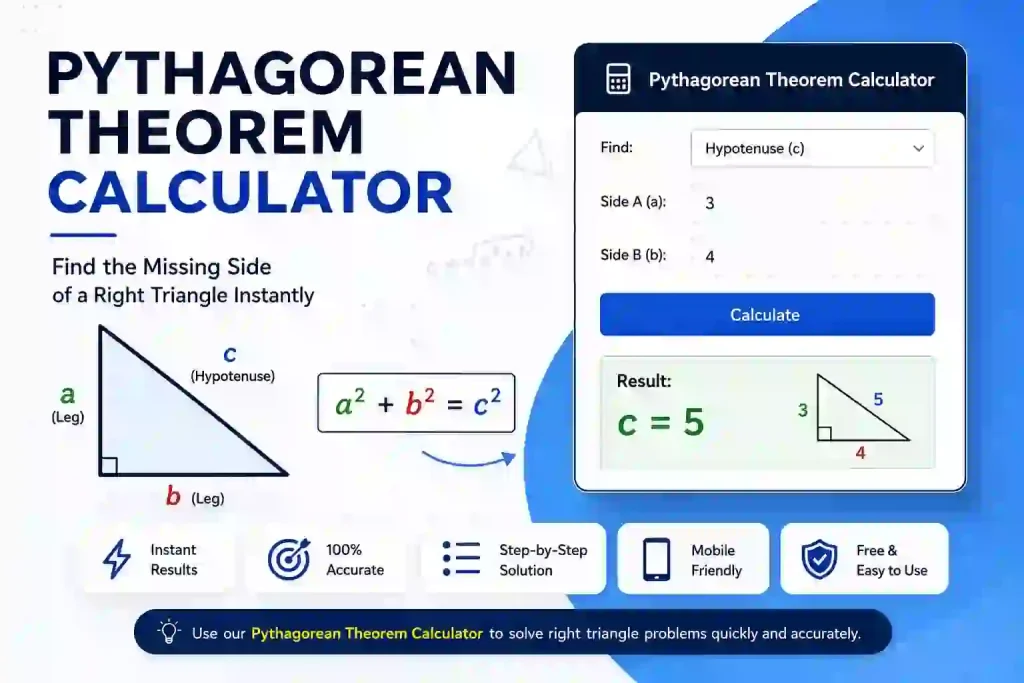
A Pythagorean Theorem Calculator makes it easy to find the missing side of a right triangle when two side lengths are known. Instead of working through the calculation manually, you can enter the known values and get an accurate result quickly.
The Pythagorean theorem is one of the most useful formulas in geometry. It describes the relationship between the two legs of a right triangle and its hypotenuse. The standard formula is:
a² + b² = c²
Here, a and b are the two legs of the right triangle, while c is the hypotenuse, which is the side opposite the 90-degree angle.
Whether you are a student solving a geometry problem, a teacher checking an answer, or someone working with measurements, this guide explains exactly how to find the missing side.
What Is a Pythagorean Theorem Calculator?
A Pythagorean Theorem Calculator is an online tool designed to calculate the unknown side of a right triangle.
You normally need two known side lengths. The calculator then applies the Pythagorean theorem to determine the missing value.
For example, suppose a right triangle has:
- Side a = 3
- Side b = 4
- Hypotenuse c = ?
Using the formula:
a² + b² = c²
3² + 4² = c²
9 + 16 = c²
25 = c²
c = 5
The missing side is 5 units.
This is the well-known 3-4-5 right triangle and is a simple example of how the theorem works.
How Does the Pythagorean Theorem Work?
The Pythagorean theorem applies specifically to right triangles, which are triangles containing one 90-degree angle.
The two shorter sides that form the right angle are called the legs. The longest side, which lies opposite the right angle, is called the hypotenuse.
The formula is:
a² + b² = c²
The letters represent:
- a = first leg
- b = second leg
- c = hypotenuse
The formula can be rearranged depending on which side you need to find.
Finding the Hypotenuse
When both legs are known, use:
c = √(a² + b²)
Example:
a = 6
b = 8
c = √(6² + 8²)
c = √(36 + 64)
c = √100
c = 10
So, the hypotenuse is 10 units.
Finding Side A
When the hypotenuse and side b are known, use:
a = √(c² − b²)
Example:
c = 13
b = 5
a = √(13² − 5²)
a = √(169 − 25)
a = √144
a = 12
The missing side is 12 units.
Finding Side B
When the hypotenuse and side a are known, use:
b = √(c² − a²)
Example:
c = 17
a = 8
b = √(17² − 8²)
b = √(289 − 64)
b = √225
b = 15
The missing side is 15 units.
How to Use a Pythagorean Theorem Calculator
Using an online calculator is straightforward.
Step 1: Identify the Right Triangle
First, make sure the triangle has a 90-degree angle. The Pythagorean theorem only works directly with right triangles.
Step 2: Identify the Hypotenuse
Look for the side opposite the right angle. This is always the hypotenuse and the longest side of a right triangle.
Step 3: Enter the Known Values
Enter the two side lengths you already know into the calculator.
For example:
Side a = 9
Side b = 12
Step 4: Select the Missing Side
Choose whether you want to find:
- Side A
- Side B
- Hypotenuse
Step 5: Calculate the Result
The calculator applies the correct form of the Pythagorean theorem and gives you the missing side.
For the example above:
c = √(9² + 12²)
c = √(81 + 144)
c = √225
c = 15
So the missing side is 15 units.
How to Find the Missing Side of a Right Triangle
Finding a missing side becomes much easier when you first determine which values you already know.
If the two legs are known, calculate the hypotenuse:
c = √(a² + b²)
If one leg and the hypotenuse are known, subtract the square of the known leg from the square of the hypotenuse.
For side a:
a = √(c² − b²)
For side b:
b = √(c² − a²)
The important point is that the hypotenuse must always be the longest side and must be opposite the right angle.
Pythagorean Theorem Examples
Example 1: Find the Hypotenuse
A right triangle has legs of 7 units and 24 units.
Formula:
a² + b² = c²
7² + 24² = c²
49 + 576 = c²
625 = c²
c = 25
Answer: 25 units
Example 2: Find a Missing Leg
A right triangle has a hypotenuse of 10 units and one leg of 6 units.
Formula:
a = √(c² − b²)
a = √(10² − 6²)
a = √(100 − 36)
a = √64
a = 8
Answer: 8 units
Example 3: Find the Other Leg
A right triangle has a hypotenuse of 26 units and one leg of 10 units.
b = √(26² − 10²)
b = √(676 − 100)
b = √576
b = 24
Answer: 24 units
These examples show that the theorem can be rearranged to find any one missing side when the other two values are known.
When Should You Use a Pythagorean Theorem Calculator?
A calculator is especially useful when:
- You need to solve a geometry homework problem.
- You want to check a manual calculation.
- The side lengths contain decimals.
- You need a quick answer without repeating the formula.
- You want to reduce arithmetic mistakes.
- You are working with measurements in construction or design.
For students, the best approach is to understand the formula first and then use the calculator to verify the result.
Why Is the Hypotenuse Important?
The hypotenuse is essential because the Pythagorean theorem is based on its relationship with the two legs.
In every right triangle, the hypotenuse is:
- Opposite the 90-degree angle
- Longer than either leg
- Represented by c in the standard formula
A common mistake is choosing the longest-looking side without checking the angle. The correct way to identify the hypotenuse is to find the side opposite the right angle.
Common Mistakes When Using the Pythagorean Theorem
Using the Formula on a Non-Right Triangle
The standard Pythagorean theorem applies to right triangles. It should not be used as-is for an arbitrary triangle.
For triangles without a right angle, another method such as the Law of Cosines may be needed.
Choosing the Wrong Hypotenuse
The hypotenuse is not simply any side you choose as c. It must be opposite the 90-degree angle.
Forgetting to Square the Values
The formula uses squared side lengths:
a² + b² = c²
Do not add the side lengths directly.
Forgetting the Square Root
After calculating c², you still need to take the square root to find c.
For example:
c² = 49
c = √49
c = 7
Subtracting in the Wrong Order
When finding a missing leg, subtract from the square of the hypotenuse:
a = √(c² − b²)
The hypotenuse must be the larger value.
Pythagorean Theorem Calculator vs Manual Calculation
Both methods use the same mathematical principle.
Manual calculation helps you understand how the formula works and is valuable for learning geometry.
A calculator is more convenient when you want quick results or need to check your work.
The best approach is to understand the calculation and then use an online tool to verify the answer.
Our Pythagorean Theorem Calculator is designed to make this process faster while keeping the underlying formula easy to understand.
Real-World Uses of the Pythagorean Theorem
The Pythagorean theorem is not limited to school mathematics. It can also help calculate distances and lengths in practical situations.
Common applications include:
Construction
Builders can use right-angle measurements to check whether corners are square and to determine diagonal distances.
Architecture and Design
Architects and designers can use right-triangle relationships when working with dimensions, layouts, and diagonal measurements.
Navigation
The relationship between horizontal and vertical movement can help determine straight-line distance.
Engineering
Engineers use geometry and distance calculations in many forms of planning and design.
Coordinate Geometry
The same mathematical relationship is closely connected to calculating distance between points on a coordinate plane. Khan Academy also describes the connection between the Pythagorean theorem and distance calculations.
Pythagorean Theorem and the Distance Formula
The distance formula is closely related to the Pythagorean theorem.
For two points:
(x₁, y₁) and (x₂, y₂)
the distance is:
d = √((x₂ − x₁)² + (y₂ − y₁)²)
This works because the horizontal and vertical differences form the two legs of a right triangle.
So, the distance formula can be understood as an application of the Pythagorean theorem.
Benefits of Using Our Pythagorean Theorem Calculator
Our calculator can help you:
- Find the missing side quickly
- Choose the appropriate calculation
- Reduce arithmetic mistakes
- Check homework answers
- Understand the relationship between the three sides
- Work with different side lengths
- Get results without performing every step manually
For learning purposes, it is still important to understand why the formula works rather than relying only on the final number.
Frequently Asked Questions
What is a Pythagorean Theorem Calculator?
A Pythagorean Theorem Calculator is an online tool that uses the Pythagorean theorem to calculate a missing side of a right triangle when two sides are known.
What is the Pythagorean theorem formula?
The basic formula is:
a² + b² = c²
Here, a and b are the legs, and c is the hypotenuse.
Can I find any missing side with the calculator?
Yes. When two valid side lengths of a right triangle are known, the missing third side can be calculated.
How do I find the hypotenuse?
Use:
c = √(a² + b²)
You can also enter the two known legs into the calculator to get the result.
How do I find a missing leg?
Use either:
a = √(c² − b²)
or:
b = √(c² − a²)
depending on which leg is unknown.
Can the Pythagorean theorem be used for every triangle?
No. The standard Pythagorean theorem applies to right triangles. For other types of triangles, different formulas may be required.
Why is the hypotenuse always the longest side?
The hypotenuse is opposite the 90-degree angle, and in a right triangle it is always longer than either of the two legs.
What happens if I enter invalid values?
A valid right triangle requires the hypotenuse to be longer than either leg. Your calculator should also reject impossible combinations and incomplete inputs.
Final Thoughts
Finding the missing side of a right triangle does not have to be difficult. Once you know which side is the hypotenuse and understand the formula a² + b² = c², you can solve a wide range of geometry problems.
A Pythagorean Theorem Calculator makes the process faster and useful for checking calculations, studying geometry, and working with real-world measurements.
For the fastest calculation, use our Pythagorean Theorem Calculator and enter the two side lengths you already know.
For additional learning, you can also review Khan Academy’s Pythagorean theorem lessons and practice problems.