
Learning how to calculate Pythagorean theorem equations is an essential math skill for geometry, algebra, engineering, construction, and real-world problem-solving. This fundamental rule provides a quick, reliable way to find the missing side length of any right triangle.
Whether you are measuring a diagonal distance, checking if a corner is perfectly square, leaning a ladder safely against a wall, or solving geometry homework, the same core formula applies. By adjusting the equation based on which side is unknown, you can solve any right-triangle problem with ease.
In this comprehensive guide, you will learn how the Pythagorean theorem works in simple terms. We will cover step-by-step formulas for finding each side, practical real-world examples, common calculation errors to avoid, and how an online calculator can instantly speed up your work.
Mastering how to calculate Pythagorean theorem step-by-step ensures accurate results every time. From identifying the hypotenuse correctly to applying the right equation, understanding these principles will give you complete confidence in right-triangle calculations.
What Is the Pythagorean Theorem?
The Pythagorean theorem describes the relationship between the three sides of a right triangle. It applies to triangles that contain one 90-degree angle.
The standard formula is:
a² + b² = c²
In this formula:
- a = one leg of the right triangle
- b = the other leg
- c = the hypotenuse
The hypotenuse is the longest side of the triangle and is located directly opposite the 90-degree angle. The other two sides are the legs that form the right angle. Khan Academy describes the theorem in the same way and uses it to find missing side lengths in right triangles.
Understanding these three parts is the first step to solving any Pythagorean theorem problem.
How to Calculate Pythagorean Theorem Values
To Calculate Pythagorean Theorem values correctly, first identify which side is missing.
There are three main possibilities:
- The hypotenuse is missing.
- Side a is missing.
- Side b is missing.
The formula changes slightly depending on which side you need to calculate.
Finding the Hypotenuse
When both legs are known, use:
c = √(a² + b²)
For example, suppose:
a = 9
b = 12
Start by squaring both legs:
9² = 81
12² = 144
Add them together:
81 + 144 = 225
Now take the square root:
c = √225
c = 15
So, the hypotenuse is 15 units.
Finding Side A
When the hypotenuse and side b are known, use:
a = √(c² − b²)
Suppose:
c = 13
b = 12
Square both known values:
13² = 169
12² = 144
Subtract:
169 − 144 = 25
Take the square root:
a = √25
a = 5
The missing side is 5 units.
Finding Side B
When the hypotenuse and side a are known, use:
b = √(c² − a²)
For example:
c = 17
a = 8
Then:
b = √(17² − 8²)
b = √(289 − 64)
b = √225
b = 15
Therefore, the missing side is 15 units.
Step-by-Step Method to Calculate Pythagorean Theorem Problems
Following a consistent process makes these problems much easier.
Step 1: Confirm the Triangle Is a Right Triangle
Look for a 90-degree angle. The standard Pythagorean theorem applies specifically to right triangles.
Step 2: Identify the Hypotenuse
Find the side opposite the 90-degree angle. That side is c and should be the longest side.
Step 3: Identify the Known Measurements
Write down the two side lengths provided in the problem.
For example:
a = 6
b = 8
c = ?
Step 4: Choose the Correct Formula
For the hypotenuse:
c = √(a² + b²)
For side a:
a = √(c² − b²)
For side b:
b = √(c² − a²)
Step 5: Substitute the Values
Replace the letters with the measurements given in the problem.
Step 6: Perform the Calculation
Square the appropriate values, add or subtract them, and then calculate the square root.
Step 7: Check the Result
Make sure the answer is reasonable. The hypotenuse should always be longer than either leg.
This approach follows the standard process used for finding missing right-triangle side lengths.
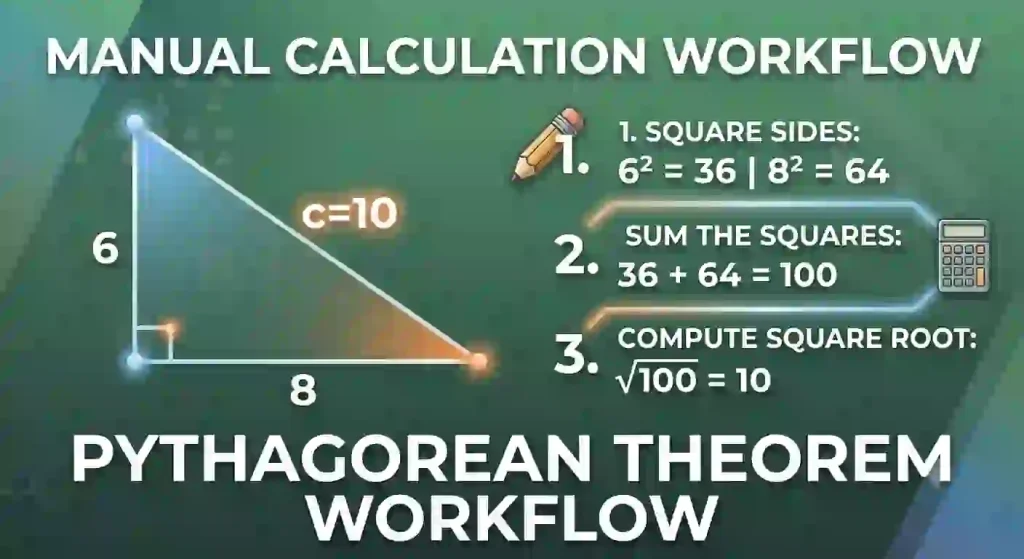
Example: Calculate Pythagorean Theorem With 6 and 8
Suppose a right triangle has:
a = 6
b = 8
You need to find c.
Start with:
c = √(a² + b²)
Substitute the values:
c = √(6² + 8²)
Square the values:
c = √(36 + 64)
Add:
c = √100
Take the square root:
c = 10
Answer
The hypotenuse is 10 units.
You can verify the result by substituting all three sides into the original formula:
6² + 8² = 10²
36 + 64 = 100
100 = 100
Because both sides are equal, the answer is correct.
Example: Find a Missing Leg
Suppose a ladder forms a right triangle against a wall.
The ladder is the hypotenuse:
c = 13 feet
The distance from the wall is:
b = 5 feet
You need to find the height a.
Use:
a = √(c² − b²)
Substitute the values:
a = √(13² − 5²)
a = √(169 − 25)
a = √144
a = 12
The ladder reaches 12 feet up the wall.
This example shows why identifying the hypotenuse correctly is important before starting the calculation.
Working With Pythagorean Triples
Some right triangles contain whole-number side lengths. These combinations are called Pythagorean triples because they satisfy the relationship:
a² + b² = c²
Common examples include:
| Side a | Side b | Hypotenuse | Verification |
|---|---|---|---|
| 3 | 4 | 5 | 3² + 4² = 5² |
| 5 | 12 | 13 | 5² + 12² = 13² |
| 6 | 8 | 10 | 6² + 8² = 10² |
| 8 | 15 | 17 | 8² + 15² = 17² |
| 7 | 24 | 25 | 7² + 24² = 25² |
One useful property is that multiplying every number in a valid triple by the same positive integer produces another valid triple.
For example, multiplying 3, 4, and 5 by 2 gives:
6, 8, 10
and:
6² + 8² = 10²
36 + 64 = 100
These examples are useful for quick mental checks and geometry exercises.
Why Use an Online Calculator?
Manually solving simple whole-number problems is straightforward, but calculations become more time-consuming when you encounter decimals, large numbers, or square roots that do not produce whole numbers.
An online calculator can help in several ways.
Faster Calculations
You can enter the known values and get the missing side without performing every arithmetic step manually.
Reduced Arithmetic Errors
Calculators reduce common mistakes involving multiplication, subtraction, and square roots.
Useful for Different Side Lengths
You can switch between finding the hypotenuse, side a, or side b depending on the information available.
Helpful for Checking Your Work
Students can solve the problem manually and then use the calculator to verify the result.
You can use our Pythagorean Theorem Calculator to calculate a missing side of a right triangle.
Common Mistakes When Calculating
The formula itself is simple, but a few mistakes can lead to incorrect results.
Forgetting the Square Root
If you calculate:
c² = 225
the answer is not 225.
You still need to calculate:
c = √225
c = 15
Using the Wrong Hypotenuse
The hypotenuse is always opposite the 90-degree angle.
Do not choose a side just because it appears longer in a poorly drawn diagram. Use the right angle to identify it.
Applying the Formula to a Non-Right Triangle
The standard Pythagorean theorem is specifically for right triangles. It should not be applied directly to an acute or obtuse triangle.
Forgetting to Square the Values
The formula is:
a² + b² = c²
not:
a + b = c
Always square the required side lengths before adding or subtracting.
Adding Instead of Subtracting
When finding a missing leg, use subtraction:
a = √(c² − b²)
or:
b = √(c² − a²)
The hypotenuse squared must be greater than the known leg squared.
Ignoring Units
If the original measurements are in feet, centimeters, meters, or inches, include the appropriate unit in the final answer.
Real-Life Applications of the Pythagorean Theorem
The Pythagorean theorem is useful in many practical situations because it provides a way to calculate direct distances from two perpendicular measurements.
Construction and Carpentry
Builders and carpenters can use the 3-4-5 relationship to check whether two lines meet at a right angle.
For example, measurements of 3 feet and 4 feet should produce a diagonal of 5 feet when the angle between them is 90 degrees.
This technique can help with framing, flooring, layouts, and other construction work.
Navigation and Distance
If you know horizontal and vertical movement, the Pythagorean theorem can help determine the straight-line distance between two positions.
Coordinate Geometry
The distance formula is closely related to the Pythagorean theorem.
For two points:
(x₁, y₁) and (x₂, y₂)
the distance is:
d = √((x₂ − x₁)² + (y₂ − y₁)²)
The horizontal and vertical differences form the legs of a right triangle, while d represents the direct distance between the two points. Khan Academy also connects the Pythagorean theorem with finding distances between points.
Computer Graphics and Game Development
In two-dimensional graphics, distances between objects or points can be calculated using the same right-triangle relationship. This makes the theorem useful when working with positions on a coordinate grid.
Word Problems
Many geometry word problems can be converted into right triangles.
Common examples include:
- Finding the height reached by a ladder
- Calculating a diagonal across a rectangular area
- Finding the direct distance between two locations
- Determining a missing side in a construction layout
Calculate Pythagorean Theorem Without a Calculator
You do not always need an online tool.
For simple numbers, manual calculation can be quick.
Consider:
a = 5
b = 12
Use:
c = √(5² + 12²)
c = √(25 + 144)
c = √169
c = 13
The calculation requires only a few steps because 5, 12, and 13 form a Pythagorean triple.
For less convenient values, an online calculator can save time and help verify your result.
How to Verify Your Answer
After you calculate a missing side, substitute all three values back into:
a² + b² = c²
For example:
a = 8
b = 15
c = 17
Check:
8² + 15² = 17²
64 + 225 = 289
289 = 289
The equation balances, so the result is correct.
You should also check whether the answer makes sense. The hypotenuse must be longer than either leg.
Frequently Asked Questions
What does Calculate Pythagorean Theorem mean?
It means using the Pythagorean theorem to determine a missing side length in a right triangle when the other two side lengths are known.
What is the formula used to Calculate Pythagorean Theorem problems?
The main formula is:
a² + b² = c²
You can rearrange it when calculating one of the legs.
Can I use the Pythagorean theorem for every triangle?
No. The standard theorem applies to right triangles containing a 90-degree angle.
How do I calculate the hypotenuse?
Use:
c = √(a² + b²)
Square both legs, add the results, and take the square root.
How do I calculate a missing leg?
Use:
a = √(c² − b²)
or:
b = √(c² − a²)
depending on which leg is unknown.
What is the easiest way to check my answer?
Put the three side lengths back into:
a² + b² = c²
If both sides of the equation are equal, your result is consistent with the theorem.
What are the most common Pythagorean triples?
Some common examples are:
3, 4, 5
5, 12, 13
8, 15, 17
7, 24, 25
These combinations produce whole-number side lengths.
Final Thoughts
Knowing how to Calculate Pythagorean Theorem problems gives you a practical method for solving missing-side questions in right triangles. Once you identify the right angle, determine the hypotenuse, choose the appropriate formula, and calculate carefully, most problems become straightforward.
The core relationship remains:
a² + b² = c²
You can use it to find the hypotenuse, calculate a missing leg, check measurements, solve geometry homework, and determine direct distances.
When you want a faster way to verify your calculations, use our Pythagorean Theorem Calculator.
For additional lessons and practice, Khan Academy provides a dedicated Pythagorean theorem section with explanations and exercises for finding missing right-triangle side lengths.