
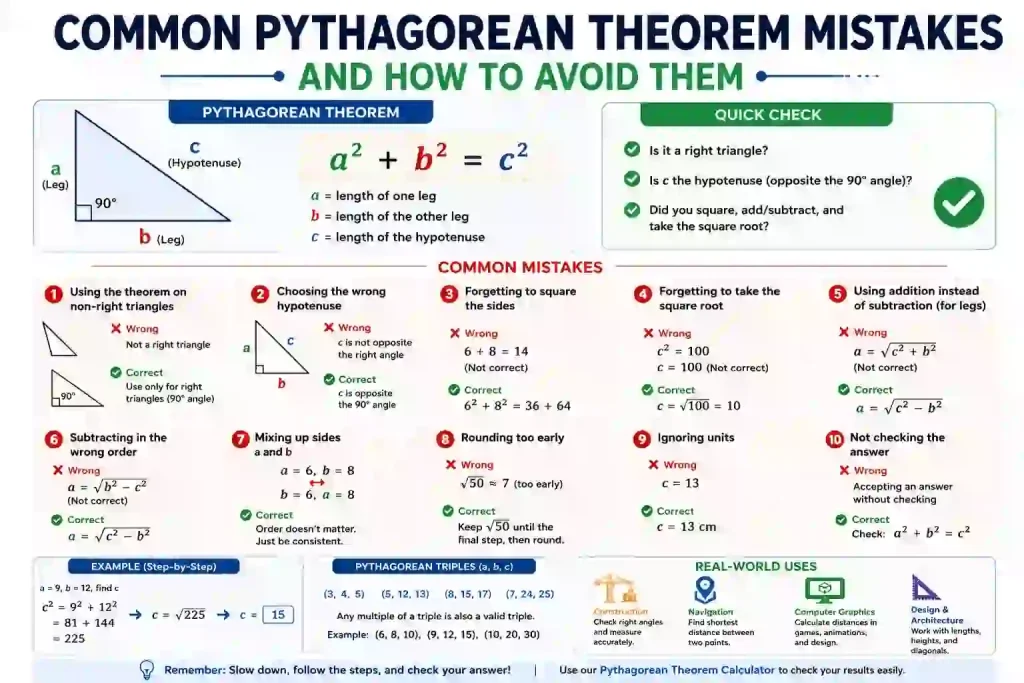
Pythagorean Theorem Mistakes are very common when students first start solving right-triangle problems. The formula itself is simple, but choosing the wrong side, forgetting to square a number, using the wrong operation, or applying the theorem to the wrong triangle can quickly produce an incorrect answer.
The good news is that most of these mistakes are easy to prevent. You simply need to follow a consistent process and check your work before accepting the final result.
The Pythagorean theorem applies to right triangles and uses the relationship:
a² + b² = c²
Here, a and b are the two legs of the triangle, while c is the hypotenuse. The hypotenuse is the side opposite the 90-degree angle and is always the longest side. (khanacademy.org)
This guide covers the most common errors, explains why they happen, and shows you how to avoid them with simple examples.
What Is the Pythagorean Theorem?
Before discussing mistakes, it is important to understand the basic rule.
The Pythagorean theorem states that the sum of the squares of the two legs of a right triangle equals the square of the hypotenuse.
The formula is:
a² + b² = c²
For example, consider a right triangle with:
a = 3
b = 4
To find the hypotenuse:
3² + 4² = c²
9 + 16 = c²
25 = c²
c = 5
The result is 5.
Khan Academy describes the theorem as a relationship between the side lengths of a right triangle and notes that knowing two side lengths allows you to determine the third. (khanacademy.org)
1. Using the Pythagorean Theorem on a Non-Right Triangle
One of the biggest Pythagorean Theorem Mistakes is using the formula on a triangle that does not contain a 90-degree angle.
The standard Pythagorean theorem applies specifically to right triangles. (khanacademy.org)
For example, a triangle with angles:
60°, 70°, and 50°
is not a right triangle.
You cannot simply use:
a² + b² = c²
for that triangle.
How to Avoid This Mistake
Always check for a 90-degree angle before using the theorem.
Look for:
- A right-angle symbol in the diagram
- An angle measurement of 90 degrees
- Two sides that are perpendicular
If there is no right angle, consider whether another method, such as the Law of Sines or Law of Cosines, is more appropriate.
2. Choosing the Wrong Hypotenuse
The hypotenuse is one of the most important parts of the theorem.
It is the side directly opposite the 90-degree angle and is always the longest side of a right triangle. (khanacademy.org)
A common mistake is assuming that c is automatically the hypotenuse without checking the diagram.
How to Identify the Hypotenuse
First, find the right angle.
Then look directly across from it.
That side is the hypotenuse.
For example:
a = 6
b = 8
c = hypotenuse
The correct relationship is:
6² + 8² = c²
36 + 64 = 100
c = 10
How to Avoid This Mistake
Do not identify the hypotenuse based only on the way the triangle looks. Use the 90-degree angle as your reference point.
3. Forgetting to Square the Side Lengths
The formula is:
a² + b² = c²
It does not mean:
a + b = c
For example, with sides 6 and 8:
Incorrect:
6 + 8 = 14
Correct:
6² + 8² = c²
36 + 64 = c²
100 = c²
c = 10
How to Avoid This Mistake
Write the formula before substituting numbers.
Then square each required value separately.
This small habit can prevent many calculation errors.
4. Forgetting to Take the Square Root
Another common mistake occurs after calculating c².
Suppose:
c² = 225
The answer is not 225.
You need to take the square root:
c = √225
c = 15
The value 225 represents c², not c.
How to Avoid This Mistake
Whenever you calculate a squared unknown, ask:
Have I taken the square root yet?
If not, the calculation is not finished.
5. Adding Instead of Subtracting When Finding a Leg
When finding the hypotenuse, you add the squares of the two legs.
But when finding a missing leg, you subtract.
For example, suppose:
c = 13
b = 5
To find a:
a = √(c² − b²)
Then:
a = √(13² − 5²)
a = √(169 − 25)
a = √144
a = 12
A common mistake is to use addition:
√(169 + 25)
That is not the correct formula for finding a missing leg.
How to Avoid This Mistake
Remember:
Find hypotenuse → Add
Find a leg → Subtract
6. Subtracting in the Wrong Order
When solving for a missing leg, the square of the hypotenuse must come first.
Correct:
a = √(c² − b²)
Incorrect:
a = √(b² − c²)
For example:
c = 10
b = 6
Correct:
a = √(10² − 6²)
a = √(100 − 36)
a = √64
a = 8
If you reverse the subtraction, you get a negative number under the square root.
How to Avoid This Mistake
Remember that the hypotenuse is always the longest side, so its square should be the larger value.
7. Mixing Up Side A and Side B
Some students think that a must always be the vertical side and b must always be the horizontal side.
That is not required.
The labels a and b can be assigned to either leg.
For example:
a = 6
b = 8
works the same way as:
a = 8
b = 6
because:
6² + 8² = 8² + 6²
How to Avoid This Mistake
Focus on the role of the side rather than its position in the drawing.
The two legs form the right angle, while c represents the hypotenuse.
8. Using the Wrong Calculator Inputs
Online calculators can make calculations easier, but incorrect input can still lead to a wrong result.
For example, if you know:
a = 9
b = 12
and want to find c, you should enter the two legs and select the hypotenuse as the unknown.
Entering 12 as the hypotenuse would produce a different problem.
How to Avoid This Mistake
Before clicking Calculate:
- Check each number.
- Confirm which side it represents.
- Make sure you selected the correct unknown.
- Check the unit of measurement.
You can use our Pythagorean Theorem Calculator to verify your work after identifying the correct values.
9. Rounding Too Early
Some problems produce decimal answers or square roots that do not simplify to whole numbers.
If you round an intermediate value too early, your final result can become less accurate.
For example, suppose a calculation produces:
c = √137
Instead of immediately replacing it with a rough decimal, keep the exact form until the final step whenever possible.
How to Avoid This Mistake
Keep the exact value during intermediate steps and round only the final answer when the problem requires rounding.
10. Forgetting the Measurement Unit
A mathematical answer is not always complete without its unit.
If the triangle measurements are in:
- centimeters
- meters
- feet
- inches
the final side length should use the same appropriate unit.
For example:
c = 15 cm
is better than simply writing:
c = 15
How to Avoid This Mistake
Check the units given in the original question and include the correct unit in your final answer.
11. Accepting an Impossible Answer
A quick reasonableness check can catch many mistakes.
The hypotenuse must be longer than either leg.
Suppose:
a = 8
b = 15
Then:
c = √(8² + 15²)
c = √289
c = 17
The result makes sense because 17 is longer than both 8 and 15.
If your calculated hypotenuse is 10 while one of the legs is 15, something went wrong.
How to Avoid This Mistake
Always ask:
Is my hypotenuse longer than both legs?
If the answer is no, check the calculation.
12. Skipping the Final Check
A calculation is not finished simply because you have a number.
You should verify the result whenever possible.
Suppose:
a = 9
b = 12
c = 15
Substitute the values back into the original formula:
9² + 12² = 15²
81 + 144 = 225
225 = 225
The equation balances, confirming the result.
How to Avoid This Mistake
After solving, substitute the answer back into:
a² + b² = c²
This gives you a quick way to identify arithmetic or setup errors.
A Complete Example: Avoiding Multiple Mistakes
Consider a right triangle with:
a = 7
b = 24
Find c.
Step 1: Confirm the Triangle
The problem identifies it as a right triangle.
Step 2: Identify the Hypotenuse
The missing side opposite the right angle is c.
Step 3: Choose the Formula
Because the hypotenuse is missing:
c = √(a² + b²)
Step 4: Substitute the Values
c = √(7² + 24²)
Step 5: Square the Values
c = √(49 + 576)
Step 6: Add
c = √625
Step 7: Take the Square Root
c = 25
Step 8: Check the Answer
7² + 24² = 25²
49 + 576 = 625
625 = 625
The answer is correct.
Notice that this process avoids several common mistakes at once: the correct triangle is used, the hypotenuse is identified correctly, the side lengths are squared, the square root is taken, and the result is verified.
A Simple Method to Prevent Pythagorean Theorem Mistakes
You do not need a complicated strategy to avoid errors. Use this simple checklist every time.
1. Identify the Right Angle
Make sure the triangle is actually a right triangle.
2. Find the Hypotenuse
The side opposite the right angle is c.
3. Identify the Unknown
Decide whether you need a, b, or c.
4. Choose the Formula
For c:
c = √(a² + b²)
For a:
a = √(c² − b²)
For b:
b = √(c² − a²)
5. Calculate Carefully
Square first, then add or subtract, and take the square root at the end.
6. Check the Result
Make sure the answer is reasonable and has the correct unit.
7. Verify the Equation
Substitute the final values back into:
a² + b² = c²
This process makes it much easier to catch mistakes before submitting your answer.
Why Use a Pythagorean Theorem Calculator?
A calculator can be helpful when you understand the formula but want to reduce repetitive arithmetic.
Our Pythagorean Theorem Calculator can help you find a missing side when two valid side lengths are known.
It can be useful for:
- Checking homework
- Verifying manual calculations
- Solving decimal measurements
- Finding the hypotenuse
- Finding a missing leg
- Working through multiple practice problems
The calculator should support your learning rather than replace it. Understanding why the formula works makes it easier to identify mistakes in both manual calculations and calculator inputs.
Pythagorean Theorem Mistakes in Word Problems
Word problems can create another layer of difficulty because you must first translate the situation into a triangle.
For example:
A ladder is 13 feet long and its base is 5 feet from a wall. How high does it reach?
Here:
- Ladder = hypotenuse
- Distance from wall = one leg
- Height on wall = missing leg
Use:
a = √(13² − 5²)
a = √144
a = 12 feet
The most important step is not the arithmetic. It is correctly identifying which measurement represents the hypotenuse.
If you need more practice, you can also read our Pythagorean Theorem Word Problems guide.
Common Mistakes When Using Pythagorean Triples
Pythagorean triples can make calculations easier, but they can also cause confusion when students assume that every triangle uses a familiar set of numbers.
Common triples include:
3, 4, 5
5, 12, 13
8, 15, 17
7, 24, 25
For example:
8² + 15² = 17²
64 + 225 = 289
The numbers work because they form a valid Pythagorean triple.
However, you should not force a problem to fit a familiar triple when the given measurements are different.
How to Avoid This Mistake
Use the actual values provided in the problem and apply the formula directly.
Pythagorean Theorem Mistakes vs. Calculation Mistakes
It helps to understand that not every incorrect answer comes from the same problem.
A formula mistake happens when you choose the wrong equation or apply the theorem to a non-right triangle.
An identification mistake happens when you choose the wrong hypotenuse or confuse the known sides.
An arithmetic mistake happens when you square, add, subtract, or take a square root incorrectly.
An input mistake happens when you enter the wrong values into a calculator.
Knowing which type of mistake you made makes it easier to correct it.
Frequently Asked Questions
What is the most common Pythagorean theorem mistake?
One of the most common mistakes is identifying the wrong hypotenuse. The hypotenuse is always opposite the 90-degree angle and is the longest side of a right triangle. (khanacademy.org)
Can I use the Pythagorean theorem on any triangle?
No. The standard Pythagorean theorem applies specifically to right triangles.
Why do I need to take the square root?
The formula gives you the square of the unknown side. Taking the square root converts that squared value into the actual side length.
Why do I subtract when finding a missing leg?
Starting with:
a² + b² = c²
you can rearrange the equation to:
a² = c² − b²
Then take the square root to find a.
Can side a and side b be switched?
Yes. The two legs can be labeled a or b in either order. The important part is that c is the hypotenuse.
How can I tell if my answer is reasonable?
The hypotenuse should be longer than both legs. You can also substitute your result back into the original formula to verify it.
Can an online calculator prevent all mistakes?
No. A calculator can reduce arithmetic errors, but you still need to enter the correct values, identify the right triangle, and choose the correct unknown.
Conclusion
Pythagorean Theorem Mistakes are usually caused by small errors in identifying the triangle, selecting the correct formula, performing the arithmetic, or checking the final result.
The easiest way to avoid them is to slow down and follow the same process every time:
Identify the right angle → Find the hypotenuse → Choose the formula → Calculate → Check the answer.
Remember the three key formulas:
c = √(a² + b²)
a = √(c² − b²)
b = √(c² − a²)
Once you understand these steps, solving right-triangle problems becomes much more reliable.
You can also use our Pythagorean Theorem Calculator to check your calculations and find missing side lengths quickly.
For additional lessons and practice, visit Khan Academy’s Pythagorean theorem resources. (khanacademy.org)