
A Triangle Area Calculator makes it easy to find the area of a triangle when you know the required measurements. Whether you are solving a geometry problem, checking homework, or working with measurements in a real-world project, understanding how triangle area is calculated can help you get accurate results.
The method you use depends on the information you have. If you know the base and height, the standard triangle area formula is usually the easiest option. For triangles where only the side lengths are known, Heron’s formula can be useful.
In this guide, you will learn how to calculate the area of a triangle, which formulas to use, how to solve different types of triangles, and how to avoid common calculation mistakes.
What Is the Area of a Triangle?
The area of a triangle represents the amount of two-dimensional space enclosed by its three sides. It is normally measured in square units, such as square inches, square feet, square meters, or square centimeters.
Unlike the perimeter, which measures the total length around a triangle, area measures the space inside it.
The most common triangle area formula is:
A = 1/2 × b × h
Here:
- A = area of the triangle
- b = base
- h = perpendicular height
The height must be measured at a right angle to the selected base.
How to Calculate the Area of a Triangle
Calculating the area of a triangle is straightforward when you know the base and perpendicular height.
Follow these steps:
- Identify the base of the triangle.
- Find the perpendicular height.
- Multiply the base by the height.
- Divide the result by 2.
- Write the answer in square units.
Example
Suppose a triangle has a base of 10 units and a height of 6 units.
Use the formula:
A = 1/2 × b × h
Substitute the values:
A = 1/2 × 10 × 6
A = 30
Therefore, the area of the triangle is 30 square units.
Triangle Area Formula
The standard formula for calculating triangle area is:
A = 1/2 × b × h
This formula works for all types of triangles as long as you know a base and its corresponding perpendicular height.
For example, consider a triangle with a base of 14 cm and a height of 8 cm.
A = 1/2 × 14 × 8
A = 56
The area is 56 square centimeters.
The most important point is that the height must correspond to the selected base. You cannot simply use any side as the height unless it forms a perpendicular measurement with the base.
How to Find the Area of a Right Triangle
A right triangle contains one 90-degree angle. Because two of its sides are perpendicular, one of those sides can usually serve as the base and the other as the height.
The area formula remains:
A = 1/2 × b × h
Example
Suppose a right triangle has legs measuring 9 units and 12 units.
A = 1/2 × 9 × 12
A = 54
Therefore, the area is 54 square units.
Right triangles are particularly easy to work with because the two perpendicular sides provide the base and height directly.
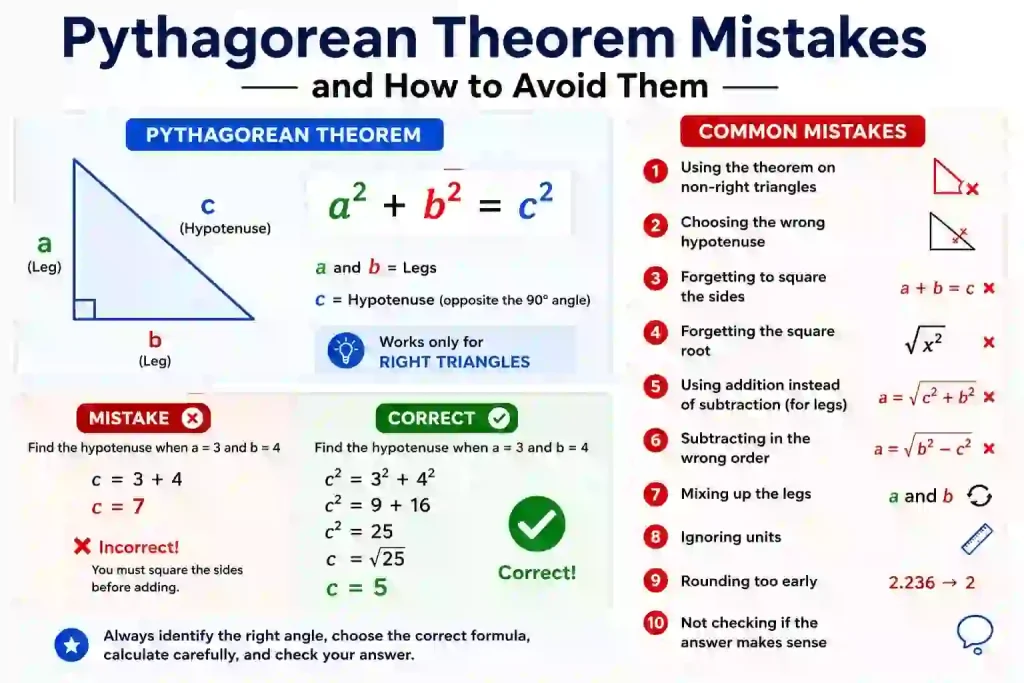
If you are also working with the side lengths of a right triangle, you can use the Pythagorean Theorem to find a missing side before calculating the area.
How to Find the Area of an Equilateral Triangle
An equilateral triangle has three equal sides and three equal angles. Each interior angle measures 60 degrees.
If the side length is known, you can use this formula:
A = √3/4 × s²
Here, s represents the length of one side.
Example
Suppose each side of an equilateral triangle is 8 units.
A = √3/4 × 8²
A = √3/4 × 64
A = 16√3
The area is approximately 27.71 square units.
For an equilateral triangle, this formula allows you to calculate the area without separately measuring the height.
How to Find the Area of an Isosceles Triangle
An isosceles triangle has two equal sides. To calculate its area using the standard formula, you need the base and perpendicular height.
If the height is not provided, you may need to calculate it first.
For example, suppose an isosceles triangle has a base of 10 units and a height of 12 units.
A = 1/2 × 10 × 12
A = 60
The area is 60 square units.
If you know the equal side lengths and the base but not the height, you can often divide the triangle into two right triangles and use the Pythagorean Theorem to find the missing height.
How to Find the Area of a Scalene Triangle
A scalene triangle has three different side lengths. You can still use the standard area formula if the base and corresponding height are known.
For example:
- Base = 15 cm
- Height = 7 cm
A = 1/2 × 15 × 7
A = 52.5
The area is 52.5 square centimeters.
When the height is not available, another method may be necessary.
How to Calculate Triangle Area Using Heron’s Formula
Heron’s formula is useful when you know all three side lengths but do not know the height.
First, calculate the semiperimeter:
s = (a + b + c) / 2
Then use:
A = √[s(s − a)(s − b)(s − c)]
Here:
- a = first side
- b = second side
- c = third side
- s = semiperimeter
- A = area
Example
Suppose the three sides of a triangle are:
a = 5
b = 6
c = 7
First calculate the semiperimeter:
s = (5 + 6 + 7) / 2
s = 9
Now use Heron’s formula:
A = √[9(9 − 5)(9 − 6)(9 − 7)]
A = √[9 × 4 × 3 × 2]
A = √216
A ≈ 14.70
Therefore, the triangle’s area is approximately 14.70 square units.
How a Triangle Area Calculator Works
A Triangle Area Calculator uses the appropriate mathematical formula based on the measurements you provide.
For a base and height, it uses:
A = 1/2 × b × h
If all three side lengths are available, a calculator may use Heron’s formula.
A good calculator can save time and reduce arithmetic errors, especially when working with decimal values or more complicated calculations.
However, understanding the formula is still important because it helps you check whether the result makes sense.
Common Triangle Area Calculation Mistakes
Even a simple area formula can lead to incorrect results if the measurements are used incorrectly.
Using the Wrong Height
The height must be perpendicular to the selected base. A slanted side is not automatically the height.
Forgetting to Divide by 2
The standard triangle area formula includes 1/2. Forgetting this step will make the result twice as large as the correct area.
Using the Wrong Units
If the base is measured in meters and the height is measured in centimeters, convert them to the same unit before calculating.
Confusing Area With Perimeter
Area measures the space inside the triangle, while perimeter measures the total distance around its edges.
Rounding Too Early
Keep accurate decimal values during the calculation and round the final answer when necessary.
Entering Incorrect Values
Double-check the base, height, and side lengths before calculating. A small input error can produce a completely different result.
How to Get More Accurate Results
You can improve the accuracy of your triangle area calculations by following a few simple habits.
First, make sure you understand which measurements the formula requires. Next, use the same unit for all measurements. Keep additional decimal places during intermediate calculations and round only the final result.
It is also helpful to estimate the expected size of the answer before calculating. This makes it easier to notice an obviously incorrect result.
For example, if the base is 20 units and the height is 10 units, the area should be around 100 square units. A result of 1,000 square units would immediately suggest an error.
Triangle Area Calculator vs. Manual Calculation
Both methods can be useful depending on your needs.
A manual calculation helps you understand the mathematical process and is especially useful for learning geometry.
A calculator is more convenient when you need quick results or want to verify your work.
The best approach is often to understand the formula first and then use a calculator to check your answer.
Real-World Uses of Triangle Area
Triangle area calculations are useful in many practical situations.
Construction
Builders and contractors may need triangle area measurements when working with roofs, walls, foundations, and other structures.
Architecture
Architects use geometric calculations when designing structures that contain triangular sections.
Engineering
Engineers can use triangle measurements in structural designs, technical drawings, and land-related calculations.
Land Measurement
Triangles can help divide irregular areas into smaller sections that are easier to measure.
Education
Students regularly use triangle area formulas when studying geometry, trigonometry, and related mathematical topics.
Frequently Asked Questions
What is the formula for the area of a triangle?
The standard formula is:
A = 1/2 × b × h
You multiply the base by the perpendicular height and divide the result by 2.
Can I calculate the area of a triangle without the height?
Yes. If you know all three side lengths, you can use Heron’s formula to calculate the area without directly knowing the height.
What is the area of a right triangle?
The area of a right triangle is calculated using:
A = 1/2 × base × height
The two perpendicular legs can serve as the base and height.
What units are used for triangle area?
Triangle area is expressed in square units. Examples include square meters, square centimeters, square feet, and square inches.
Can a Triangle Area Calculator calculate different types of triangles?
Yes. Depending on the available measurements, a calculator can calculate the area of right, equilateral, isosceles, and scalene triangles using the appropriate formula.
Why is triangle area divided by 2?
A triangle can be thought of as half of a rectangle or parallelogram with the same base and height. That is why the standard area formula includes 1/2.
Quick Triangle Area Checklist
Before finalizing your calculation, check the following:
- Did you identify the correct base?
- Is the height perpendicular to the base?
- Are all measurements in the same unit?
- Did you multiply the base and height?
- Did you divide the result by 2?
- Did you use the correct formula for the triangle?
- Did you avoid rounding too early?
- Is your final answer written in square units?
Conclusion
Calculating the area of a triangle becomes much easier when you know which formula matches the information available. For a known base and perpendicular height, the standard formula is A = 1/2 × b × h. When all three side lengths are known, Heron’s formula provides another useful method.
A Triangle Area Calculator can make the process faster and help you verify your calculations. However, understanding how the formulas work allows you to identify errors and confidently check your results.
Whether you are studying geometry, checking homework, or working with real-world measurements, learning how to calculate triangle area is a valuable mathematical skill.